Generative AI and the Future of Work: Complete Guide 2025
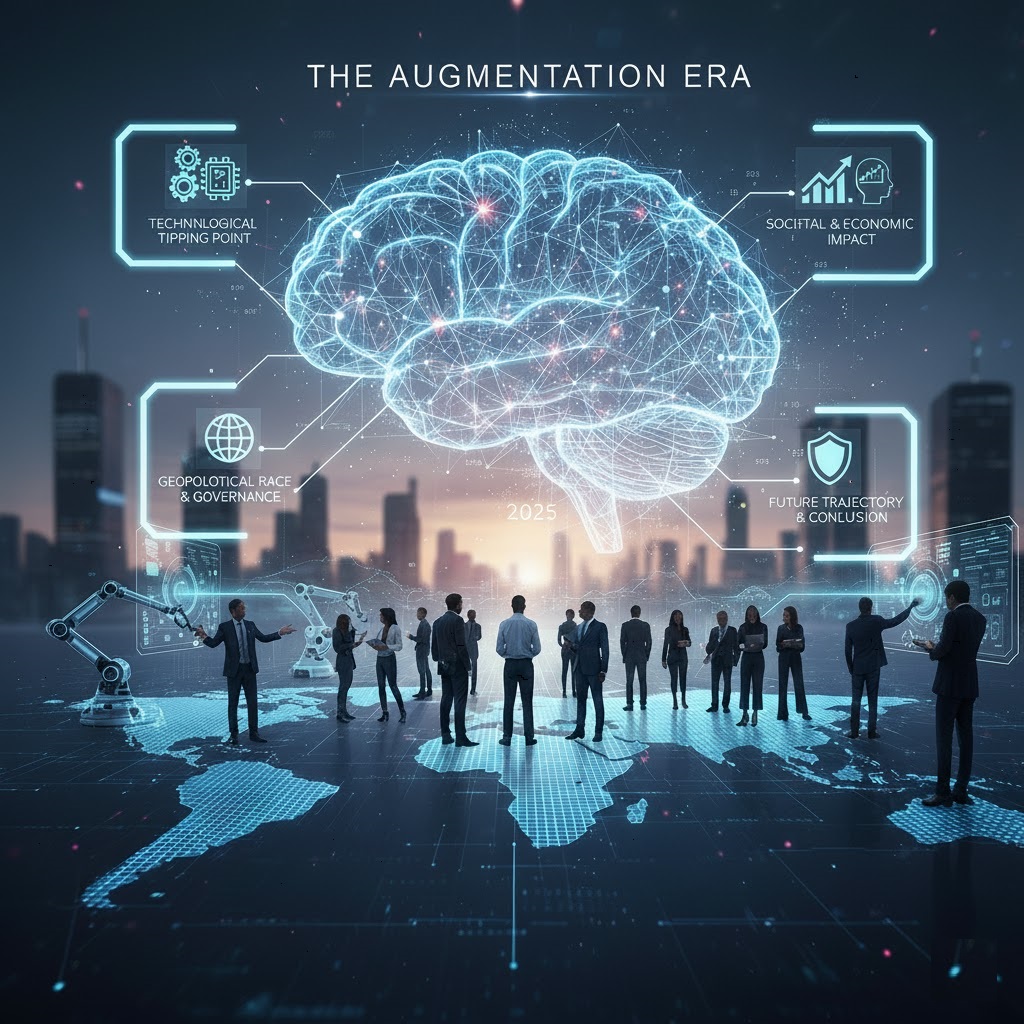
The Augmentation Era: Analyzing the Global AI Revolution (2024–2025)
The current surge in Artificial Intelligence (AI) is not merely an incremental technological upgrade; it represents a paradigm shift comparable in scope to the invention of the printing press or the rise of the internet. Defined by the rapid, commercial-scale deployment of generative and multimodal models, the Generative AI impact of the 2024–2025 revolution is already reshaping global economic structures, demanding urgent governance, and fundamentally redefining the nature of human work and creativity.
1. The Technological Tipping Point
The current generation of AI is fundamentally different from previous waves; such as the expert systems of the 1980s or the deep learning specialization of the 2010s due to three interconnected breakthroughs:
- The Transformer Architecture: This core innovation, coupled with the attention mechanism, allowed models to process vast sequences of data (text, images, code) in parallel, dramatically accelerating training and enabling the current scale of Large Language Models (LLMs), such as ChatGPT, Gemini and Claude etc.
- Massive Scaling & Big Data: Adherence to a kind of “Model Scaling Law” (analogous to the exponential growth captured by Moore’s Law for transistors) demonstrated that performance improvements were directly correlated with the quantity of parameters, the size of the training dataset, and the computational power used. This scale unlocked emergent capabilities, allowing models to perform tasks they were not explicitly trained for, such as complex reasoning or sophisticated coding.
- Multimodality and Agentic AI: The fusion of text, image, and code capabilities within a single architecture (multimodality) has created genuinely versatile AI tools. Furthermore, the development of Agentic AI systems capable of breaking down complex goals into sub-tasks and executing them autonomously moves AI from a passive tool to an active collaborator or even an independent virtual worker.
This shift means AI is no longer a specialized tool for classification (like image recognition or video generation) but a powerful, general purpose platform capable of abstract reasoning and content creation at a human or superhuman level.
2. Societal & Economic Impact
The speed of AI adoption has initiated a rapid restructuring across key societal pillars, creating both unprecedented productivity gains and significant disruption.
Workforce and Jobs: Augmentation vs. Displacement
The primary economic effect is job polarization. Routine and predictable tasks, including significant portions of administrative work, coding, and basic legal research, are being rapidly automated, leading to job displacement estimates reaching into the hundreds of millions globally over the next decade.
Conversely, AI creates a high demand for new, augmentation-focused roles:
- Prompt Engineers and AI Communicators: Professionals who specialize in communicating effectively with AI models.
- AI Ethicists and Auditors: Roles focused on ensuring models are fair, compliant, and safe.
- Super-Augmented Professionals: Domain experts (e.g., lawyers, doctors, data analysts) whose productivity is multiplied by using AI as a “co-pilot,” focusing their efforts on judgment, complex problem-solving, and human interaction.
The challenge is a massive, immediate need for upskilling and reskilling to bridge the gap between displaced and augmented workers.
Education: The Hyper-Personalized Challenge
AI, especially through LLMs, is poised to create hyper-personalized learning pathways, tailoring curriculum and pacing to individual student needs, potentially realizing a centuries-old pedagogical dream. However, it poses an existential threat to traditional assessment models. The ease with which students can generate sophisticated, original-sounding essays, code, and analysis forces institutions to shift focus from measuring rote knowledge to evaluating critical thinking, human-centric project work, and the effective use of AI tools.
Creative Industries: IP, Synthetic Media, and the Co-Pilot
The impact on the creative sector is marked by extreme tension. AI tools democratize creation, allowing anyone to generate professional-grade art, music, and video (“Creativity Without Borders”). However, this rapid proliferation has ignited complex, high-stakes battles over Intellectual Property (IP), as models are trained on vast corpora of copyrighted material. The simultaneous rise of convincing synthetic media (deepfakes) challenges public trust and information integrity, compelling governments and platforms to develop sophisticated provenance and detection tools. The future of creativity hinges on the adoption of the “co-creator” or “co-pilot” model, where human artists guide the AI tool, blending human intent with machine efficiency.
3. The Geopolitical Race & Governance
The AI revolution is a central front in geopolitical competition, driving fragmented and sometimes conflicting approaches to governance.
| Actor | Governance Philosophy | Key Focus/Mechanism | Implication |
| EU (Europe) | Regulation-First (Human-Centric) | AI Act: Comprehensive, risk-based framework (banning ‘unacceptable’ risk, strict rules for ‘high’ risk). | Sets a global standard (The Brussels Effect) prioritizing fundamental rights and limiting government power. |
| US (America) | Innovation-First (Sector-Specific) | Presidential Executive Orders, reliance on existing FTC/FDA/DOJ authority, and massive funding. | Favors rapid development and commercial leadership; regulation is often reactive, fragmented, and lacks a unified federal law. |
| China | State Control & National Security | Vertical Regulation: Specific, iterative rules on algorithms, deep synthesis, and generative AI; algorithm filing requirements. | Prioritizes national interests, technological sovereignty, and content control, balancing innovation with strict oversight. |
This contrasting landscape reflects differing national values, but the lack of a unified global regulatory body poses significant risks for issues that transcend borders. Deep research methodoligies might be very helpful to know the revolution of generative AI impact on future businesses.
Critical Unresolved Ethical Dilemmas:
- Algorithmic Bias and Fairness: The deployment of large models trained on biased or historically incomplete data risks scaling systemic inequality in hiring, lending, and justice systems.
- Existential and Catastrophic Risk: The long-term, low-probability but high-impact risks associated with increasingly autonomous and powerful AI systems (including misuse for biological/cyber warfare or loss of human control) are driving calls for robust safety research and regulatory “kill switches.”
- Concentration of Power: The immense capital and computational resources required to train frontier models (driven by the high cost of specialized chips and training data) consolidate power among a handful of well-funded tech giants, creating a digital oligopoly that threatens market competition and democratic oversight.
4. Future Trajectory
The immediate future of AI will be dominated by the commercialization of agentic systems and the convergence of physical and digital AI (robotics, autonomous vehicles). Investment trends, buoyed by the belief in compounding returns (Venture Capital in AI), suggest a continuation of hyper-innovation in the next few years.
Will this revolution lead to a societal flourishing defined by augmentation, or a societal crisis defined by displacement and control?
The current trajectory suggests a simultaneous movement toward both, a Bifurcated Future. The revolution will, on one hand, lead to unprecedented human flourishing in fields like medicine and scientific discovery, driven by powerful AI augmentation. On the other hand, without proactive, globally coordinated governance and a massive commitment to education reform and social safety nets, it risks exacerbating societal crisis, widening inequality, consolidating corporate power, and undermining democratic institutions through synthetic information. The ultimate outcome is not predetermined by the technology itself, but by the speed and wisdom of the human policy and ethical frameworks developed in the next 24 months.
Conclusion: Navigating the Bifurcated Future
The “Augmentation Era” is not a distant prediction; it is the current reality, defined by the rapid commercialization of powerful generative and multimodal AI. As explored throughout this analysis, the Generative AI impact is fundamentally bifurcated. On one hand, we see unprecedented potential for human flourishing, super-augmented productivity, personalized education, and leaps in scientific discovery. On the other hand, we face escalating societal crises: the mass displacement of routine work, complex battles over IP and synthetic media, the chilling threat of algorithmic bias, and the consolidation of power within a digital oligopoly.
The technology itself does not predetermine the outcome of the 2024–2025 revolution, but rather by our collective wisdom and speed in governance. From the EU’s regulation-first approach to the US’s innovation-first strategy, the global policy landscape is fragmented. Yet, the need for coordinated action on ethical dilemmas and catastrophic risks is universal and urgent.
The future is not a passive event to be watched, but a challenge to be met. The speed and depth of this technological shift demand an immediate, massive commitment to upskilling, policy reform, and ethical scrutiny. It is in these human frameworks, developed and deployed within the next two years, that we will ultimately determine whether the AI revolution leads us toward a crisis of displacement or a new dawn of collaborative augmentation.
The next stage requires action, not observation. How will your organization respond to the Augmentation Era?
Will Generative AI Replace Your Job? The Truth About AI and Employment
The Fear Is Real—But Misunderstood
If you’re worried about AI taking your job, you’re not alone. Recent surveys show that 60% of workers express concern about job security due to artificial intelligence. But here’s what the data actually tells us: AI isn’t simply replacing jobs—it’s transforming how we work.
The relationship between generative AI and employment is far more nuanced than “robots stealing jobs.” Let’s break down what’s really happening.
The Data: What Research Actually Shows
Jobs Displaced vs. Jobs Created
The Reality:
- Certain tasks will be automated (30-40% of work hours could be impacted by AI)
- New roles are emerging faster than expected
- Most jobs will be augmented, not eliminated
Key Research Findings:
The World Economic Forum’s Future of Jobs Report 2023 projects:
- 83 million jobs may be displaced by 2027
- BUT 69 million new jobs will be created
- Net effect: Significant job transformation, not mass unemployment
Goldman Sachs research suggests:
- 300 million full-time jobs globally could be affected
- However, AI could ultimately increase global GDP by 7%
- Historical precedent: Technology creates more jobs than it destroys
Which Jobs Are Most at Risk?
HIGH RISK (70-80% automation potential):
- Data entry clerks
- Telemarketers
- Assembly line workers
- Basic bookkeeping roles
- Routine customer service positions
- Simple content writing (listicles, basic reporting)
MEDIUM RISK (30-50% automation potential):
- Paralegals (research tasks)
- Junior financial analysts
- Basic graphic designers
- Entry-level programmers (simple coding)
- Medical transcriptionists
- Travel agents
LOW RISK (10-20% automation potential):
- Healthcare professionals (doctors, nurses)
- Strategic planners
- Creative directors
- Therapists and counselors
- Skilled tradespeople (electricians, plumbers)
- Teachers and educators
- Senior managers and executives
Augmentation vs. Replacement: The Critical Distinction
What Does “Augmentation” Actually Mean?
Rather than AI replacing workers, most organizations are discovering that human + AI dramatically outperforms either alone.
Real-World Examples:
Radiologists + AI:
- AI alone: 88% diagnostic accuracy
- Human alone: 86% accuracy
- Human + AI together: 95% accuracy
- Result: Radiologists aren’t replaced; they’re more effective
Customer Service Reps + AI:
- AI handles routine inquiries (60% of tickets)
- Humans focus on complex, high-value interactions
- Average resolution time decreased by 40%
- Customer satisfaction increased by 28%
- Result: Jobs evolved, not eliminated
Software Developers + GitHub Copilot:
- Code completion speeds up by 55%
- Developers spend less time on boilerplate code
- More time for architecture and problem-solving
- Result: 2x productivity, not 50% fewer developers
The Pattern Across Industries
What AI is Good At:
- Processing large volumes of data
- Recognizing patterns
- Automating repetitive tasks
- Generating first drafts
- Providing 24/7 availability
What Humans Excel At:
- Complex decision-making with incomplete information
- Emotional intelligence and empathy
- Creative problem-solving
- Building relationships and trust
- Ethical judgment
- Strategic thinking
- Adapting to novel situations
New Jobs Being Created by Generative AI
Roles That Didn’t Exist 5 Years Ago
1. Prompt Engineers
- Salary range: $175,000-$335,000
- Design and optimize AI prompts
- Bridge between technical teams and business needs
2. AI Ethics Officers
- Salary range: $150,000-$250,000
- Ensure responsible AI deployment
- Manage bias, privacy, and fairness concerns
3. AI Training Specialists
- Salary range: $80,000-$150,000
- Train employees on AI tool usage
- Develop AI literacy programs
4. AI Product Managers
- Salary range: $140,000-$220,000
- Oversee AI product development
- Translate business needs into AI solutions
5. AI Content Editors
- Salary range: $60,000-$110,000
- Refine and verify AI-generated content
- Ensure brand voice and accuracy
6. Synthetic Data Engineers
- Salary range: $120,000-$200,000
- Create training data for AI models
- Ensure data privacy and quality
7. Human-AI Interaction Designers
- Salary range: $95,000-$170,000
- Design intuitive AI interfaces
- Optimize human-AI collaboration
Industry-Specific New Roles
Healthcare:
- AI-assisted diagnostics coordinator
- Clinical AI implementation specialist
- Medical AI data annotator
Legal:
- AI legal research analyst
- Contract AI specialist
- E-discovery AI coordinator
Marketing:
- AI content strategist
- Generative AI campaign manager
- AI analytics interpreter
The Skills That Will Keep You Employed
The 3 Categories of AI-Proof Skills
1. Uniquely Human Skills (AI Can’t Replicate)
Emotional Intelligence:
- Reading non-verbal cues
- Building genuine relationships
- Navigating office politics
- Conflict resolution
- Empathetic communication
Complex Problem-Solving:
- Handling ambiguous situations
- Making decisions with incomplete data
- Thinking outside established patterns
- Integrating diverse knowledge domains
Creativity & Innovation:
- Original ideation
- Connecting disparate concepts
- Challenging assumptions
- Artistic expression
2. AI-Enhanced Skills (Become More Powerful With AI)
Strategic Thinking:
- Use AI for data analysis
- Apply human judgment to recommendations
- Focus on high-level strategy while AI handles details
Content Creation:
- AI generates drafts
- Humans refine for nuance, brand voice, and emotion
- Higher volume without sacrificing quality
Project Management:
- AI automates scheduling, tracking
- Humans focus on stakeholder management
- Better risk assessment with AI insights
3. Technical AI Literacy
Understanding AI Capabilities:
- What AI can and cannot do
- How to effectively prompt AI tools
- Interpreting AI outputs critically
- Recognizing AI limitations and biases
Tool Proficiency:
- ChatGPT, Claude, Gemini for various tasks
- Industry-specific AI tools
- AI-powered analytics platforms
- Generative design tools
Real Talk: Industries Facing the Biggest Disruption
1. Customer Service & Support
What’s Changing:
- AI chatbots handling 60-80% of basic inquiries
- Sentiment analysis tools for routing complex issues
- Automated ticket categorization
Human Jobs Evolving:
- Focus on complex, high-emotion interactions
- Become “AI supervisors” monitoring quality
- Handle escalations requiring empathy
- Train AI on edge cases
Job Outlook: Transformation, not elimination. Need 30-40% fewer entry-level roles, but senior roles become more specialized and higher-paid.
2. Content Creation & Media
What’s Changing:
- AI writing basic news, product descriptions, social posts
- AI is generating images, videos, and music
- Automated content personalization
Human Jobs Evolving:
- Strategic content planning
- Brand voice refinement
- Editorial oversight and fact-checking
- Complex investigative journalism
- Creative direction
Job Outlook: Junior roles decline, senior creative roles remain strong. Freelancers who adapt thrive.
3. Software Development
What’s Changing:
- AI code generation (GitHub Copilot, Amazon CodeWhisperer)
- Automated testing and debugging
- Documentation generation
Human Jobs Evolving:
- System architecture and design
- Complex problem decomposition
- Security and optimization
- Code review with AI assistance
- Cross-functional communication
Job Outlook: High demand continues. Developers become more productive, not obsolete.
4. Finance & Accounting
What’s Changing:
- Automated bookkeeping and data entry
- AI-powered fraud detection
- Algorithmic trading
- Financial report generation
Human Jobs Evolving:
- Strategic financial planning
- Complex tax strategy
- Client relationship management
- Regulatory compliance interpretation
- Investment strategy
Job Outlook: Entry-level roles decline 20-30%, but senior advisory roles grow.
5. Legal Services
What’s Changing:
- AI contract review and analysis
- Legal research automation
- Document generation
- E-discovery automation
Human Jobs Evolving:
- Strategy and argumentation
- Client counseling
- Negotiation
- Court representation
- Ethical decision-making
Job Outlook: Paralegals and junior associates are most affected. Senior attorneys see productivity gains.
The Historical Perspective: Technology Always Creates Jobs
We’ve Been Here Before
1800s: Industrial Revolution
- Fear: Machines will replace farmers and craftsmen
- Reality: Manufacturing jobs exploded, creating the middle class
- New industries: Railroads, factories, urban development
1980s: Personal Computers
- Fear: Computers will eliminate office jobs
- Reality: Created the tech industry, digital marketing, and IT careers
- Net effect: Millions of new jobs created
2000s: Internet & E-commerce
- Fear: Online shopping will kill retail
- Reality: Created digital marketing, logistics, and UX design
- New roles: Social media managers, SEO specialists, influencers
2010s: Smartphones & Apps
- Fear: Apps will replace service workers
- Reality: Gig economy, app development, digital content creation
- Uber, Airbnb, and DoorDash created entirely new job categories
The Pattern
Technology disrupts specific tasks, not entire occupations. When tasks get automated:
- Workers shift to higher-value activities
- Productivity increases lower costs
- Lower costs increase demand
- Increased demand creates new jobs
- New technologies create entirely new industries
AI is following the same pattern.
How to Future-Proof Your Career
Immediate Actions (Start This Week)
1. Experiment With AI Tools
- Spend 30 minutes daily using ChatGPT, Claude, or similar
- Apply AI to your current work tasks
- Learn what it does well (and poorly)
- Become the “AI person” on your team
2. Identify Your Irreplaceable Skills
- What do you do that requires human judgment?
- Where do you add emotional value?
- What tasks involve building relationships?
- Focus on developing these further
3. Document Your AI-Enhanced Workflow
- Keep track of productivity gains
- Quantify time saved
- Build a portfolio of AI-assisted work
- Demonstrate value to employers
Medium-Term Strategy (Next 6-12 Months)
1. Formal AI Training
- Take online courses (Coursera, LinkedIn Learning)
- Attend workshops and webinars
- Get certified in relevant AI tools
- Join AI communities
2. Pivot Your Role
- Volunteer for AI implementation projects
- Propose AI solutions to current problems
- Position yourself as an innovation leader
- Bridge technical and business teams
3. Build a Hybrid Skill Set
- Combine domain expertise with AI literacy
- Example: Accountant + AI analytics = Strategic Financial Analyst
- Example: Teacher + AI tools = Personalized Learning Designer
- Example: Marketer + Generative AI = AI Content Strategist
Long-Term Career Planning (1-5 Years)
1. Continuously Adapt
- AI capabilities evolve rapidly
- Commit to lifelong learning
- Stay informed on industry trends
- Network with AI practitioners
2. Move Up the Value Chain
- Shift from execution to strategy
- Focus on decision-making roles
- Develop leadership capabilities
- Become the person who directs AI, not competes with it
3. Consider Adjacent Career Moves
- If your role is high-risk, explore related fields
- Use transferable skills
- Industries adopting AI more slowly (healthcare, education) buy time
- Entrepreneurship opportunities in AI-native businesses
The Bottom Line: Adapt, Don’t Fear
Key Takeaways
- AI is a tool, not a replacement – Most jobs will be augmented, not eliminated
- New opportunities emerging – AI creates more jobs than it displaces, historically and currently
- Human skills matter more – Emotional intelligence, creativity, and strategic thinking are more valuable than ever
- Early adopters win – Workers who embrace AI now will have a competitive advantage
- Continuous learning is essential – The job market rewards adaptability
Final Thought
The question isn’t “Will AI replace jobs?” The real question is: “Will I adapt to work effectively with AI, or will someone who has replace me?”
Your job isn’t under threat from AI itself. It’s under threat from people who know how to use AI better than you do.
The good news? You’re reading this guide, which means you’re already taking the first step toward an AI-augmented future. Keep learning, keep experimenting, and keep adapting.
The future of work isn’t human vs. AI—it’s human + AI. Choose to be on the winning side.
What’s Next?
Now that you understand the reality of AI and jobs, the next step is developing the specific skills you need. Check out our guide on [Essential Skills for the AI Workplace] and start building your AI-proof career today.
What skills do you need to thrive in this AI-augmented workplace?
The answer isn’t just “learn AI.” It’s more nuanced. You need a combination of three skill categories:
- Technical AI Literacy (understanding how to use AI tools)
- Amplified Human Skills (capabilities AI can’t replicate)
- Adaptive Meta-Skills (ability to continuously learn and evolve)
Let’s break down each category with specific, actionable development strategies.
Category 1: Technical AI Literacy
What This Means
You don’t need to become a machine learning engineer. But you DO need to understand:
- How to effectively use AI tools in your daily work
- When to use AI vs. when to rely on human judgment
- How to evaluate and verify AI outputs
- Basic prompt engineering for better results
Core Technical Skills to Develop
1. Prompt Engineering Fundamentals
What it is: The art of communicating effectively with AI to get optimal results.
Why it matters: The difference between mediocre and excellent AI output is 80% about how you prompt it.
How to develop:
- Practice daily: Use ChatGPT or Claude for 30 minutes each day
- Learn patterns: Study effective prompt structures
- Role assignment: “Act as a [expert]…”
- Context provision: “Given that [background]…”
- Clear instructions: “Create a [specific output]…”
- Output formatting: “Provide results as [format]…”
- Experiment: Try different phrasings for the same task
- Document what works: Keep a “prompt library” of successful templates
Resources:
- Learn Prompting (free course)
- PromptingGuide.ai
- Our guide: [Chain of Thought Prompting]
Time investment: 2-3 weeks to basic proficiency, ongoing refinement
2. AI Tool Proficiency
Essential tools to master (choose based on your field):
General Productivity:
- ChatGPT/Claude: Writing, analysis, brainstorming
- Notion AI: Note-taking and organization
- Grammarly: Writing enhancement
Content Creation:
- Midjourney/DALL-E: Image generation
- Jasper/Copy.ai: Marketing copy
- Descript: Video/audio editing
Coding & Development:
- GitHub Copilot: Code completion
- Cursor: AI-powered IDE
- Replit: AI-assisted coding
Data Analysis:
- Tableau with AI: Data visualization
- Julius AI: Data analysis assistant
- Excel/Sheets Copilot: Spreadsheet automation
Design:
- Figma AI: UI/UX design assistance
- Canva AI: Graphic design
- Adobe Firefly: Creative generation
How to develop:
- Start with one tool: Master it before moving to the next
- 30-day challenge: Use the tool for real work tasks daily
- Compare outputs: Human work vs. AI-assisted work vs. pure AI
- Track ROI: Measure time saved and quality improvements
Time investment: 1-2 weeks per tool for working proficiency
3. AI Output Evaluation & Verification
What it is: Critical thinking skills to assess AI-generated content for accuracy, bias, and appropriateness.
Why it matters: AI hallucinates, produces biased content, and sometimes generates plausible-sounding nonsense. You need to catch these issues.
Skills to develop:
- Fact-checking AI claims: Always verify statistics, dates, and quotes
- Bias detection: Recognize when AI reflects training data biases
- Context appropriateness: Assess if AI output fits your specific situation
- Quality assessment: Determine if output meets professional standards
How to develop:
- Red team your AI outputs: Actively look for errors
- Cross-reference: Check AI facts against authoritative sources
- Test edge cases: Give AI intentionally tricky prompts
- Compare multiple AI tools: See where they disagree
- Get human review: Have colleagues critique your AI-assisted work
Practice exercise: Ask AI a question about your domain expertise. Identify everything it gets wrong or oversimplifies.
Time investment: Ongoing practice, integrated with tool usage
4. Understanding AI Capabilities & Limitations
What you need to know:
AI is currently GOOD at:
- Pattern recognition in data
- Language generation and translation
- Summarizing large volumes of text
- Generating variations and iterations
- Answering well-documented questions
- Code completion and debugging
- Creating images from descriptions
AI currently STRUGGLES with:
- Truly novel creative insights
- Real-time information (unless connected to search)
- Complex multi-step reasoning (improving rapidly)
- Understanding context and nuance
- Emotional intelligence
- Making ethical judgments
- Physical world understanding
How to develop this knowledge:
- Read AI news weekly: Follow AI-focused newsletters
- Test boundaries: Give AI progressively harder tasks
- Join communities: r/ChatGPT, AI Discord servers
- Attend webinars: Monthly AI tool updates and demos
Time investment: 2-3 hours per month to stay current
Category 2: Amplified Human Skills
These are skills that AI enhances rather than replaces. As AI handles routine tasks, these “uniquely human” capabilities become MORE valuable, not less.
Core Human Skills to Amplify
1. Emotional Intelligence (EQ)
Why it’s critical: AI can recognize emotion but can’t genuinely feel or respond with authentic empathy.
Components to develop:
- Self-awareness: Understanding your own emotions and triggers
- Self-regulation: Managing reactions under stress
- Empathy: Genuinely understanding others’ perspectives
- Social skills: Building authentic relationships
- Motivation: Inspiring yourself and others
How to develop:
- Mindfulness practice: 10 minutes daily meditation
- Seek feedback: Ask colleagues about your emotional impact
- Active listening: Practice full attention in conversations
- Conflict resolution: Volunteer to mediate disputes
- Coach others: Teaching develops your own EQ
AI application: Use AI to draft communications, then add emotional nuance and personalization based on relationship context.
Time investment: Lifelong journey; meaningful progress in 3-6 months
2. Creative Problem-Solving
Why it’s critical: AI generates solutions based on patterns it’s seen. Humans can think completely outside existing frameworks.
Skills to develop:
- Lateral thinking: Connecting unrelated concepts
- Constraint removal: Questioning assumptions
- Divergent thinking: Generating many possibilities
- Synthesis: Combining ideas in novel ways
- Experimentation: Testing unconventional approaches
How to develop:
- Daily creativity exercises: “How might we…?” challenges
- Cross-domain learning: Study fields unrelated to yours
- Brainstorming techniques: SCAMPER, Six Thinking Hats
- Prototype rapidly: Build quick tests of ideas
- Embrace failure: Learn from unsuccessful experiments
AI application: Use AI to generate initial ideas, then combine and evolve them in unexpected ways.
Time investment: 30 minutes daily practice, improvement in 2-3 months
3. Strategic Thinking & Judgment
Why it’s critical: AI provides data and recommendations. Humans make final decisions considering broader context, values, and long-term implications.
Skills to develop:
- Systems thinking: Understanding interconnections
- Long-term vision: Seeing beyond immediate outcomes
- Risk assessment: Weighing potential consequences
- Stakeholder analysis: Considering all affected parties
- Value alignment: Ensuring decisions reflect principles
How to develop:
- Case study analysis: Study strategic decisions (good and bad)
- Scenario planning: “What if?” exercises
- Mentorship: Learn from experienced strategists
- Post-mortems: Analyze your past decisions
- Board games: Chess, Go develop strategic thinking
AI application: Use AI to analyze data and model scenarios, then apply human judgment to make final strategic calls.
Time investment: Years to master, but noticeable improvement in 6-12 months
4. Relationship Building & Networking
Why it’s critical: Business runs on trust. AI can’t build genuine human connections.
Skills to develop:
- Authentic communication: Being genuinely yourself
- Trust building: Following through on commitments
- Network cultivation: Maintaining connections over time
- Mentoring: Supporting others’ growth
- Collaboration: Working effectively in teams
How to develop:
- Regular check-ins: Connect with the network monthly
- Give before asking: Offer value without expecting return
- Face-to-face priority: Video calls > phone > email for important relationships
- Vulnerability: Share challenges, not just successes
- Follow-up: Remember details about people’s lives
AI application: Use AI to draft initial messages and track relationships, but keep interactions genuinely human.
Time investment: Ongoing; relationships compound over the years
5. Complex Communication
Why it’s critical: AI can write clearly, but humans handle nuance, persuasion, and communication adapted to specific audiences in real-time.
Skills to develop:
- Storytelling: Crafting compelling narratives
- Persuasion: Changing minds ethically
- Presentation: Engaging in public speaking
- Negotiation: Finding win-win outcomes
- Difficult conversations: Addressing conflict constructively
How to develop:
- Toastmasters or similar: Public speaking practice
- Write regularly: Blog, journal, or contribute articles
- Study persuasion: Read “Influence” by Cialdini
- Role-play negotiations: Practice with colleagues
- Teach: Explaining concepts deepens understanding
AI application: Use AI to structure content and generate drafts, then refine for a specific audience and context.
Time investment: 6-12 months for significant improvement
Category 3: Adaptive Meta-Skills
These are “skills about skills”—the ability to continuously learn and adapt as AI evolves.
Core Adaptive Skills
1. Learning Agility
What it is: The ability to quickly master new tools, concepts, and ways of working.
How to develop:
- Learning sprints: Master one new tool per month
- Cross-training: Learn skills adjacent to your core expertise
- Failure tolerance: View mistakes as data
- Growth mindset: Believe skills are developable
- Meta-learning: Learn how YOU learn best
Practice: Take a skill completely outside your domain. Learn the basics in 20 hours using AI assistance.
2. Change Management
What it is: Thriving during uncertainty and helping others navigate change.
How to develop:
- Embrace change personally: Volunteer for new initiatives
- Study transitions: Read about industry disruptions
- Support others: Help colleagues adapt
- Anticipate trends: Develop informed predictions
- Build resilience: Stress management techniques
Practice: Lead an AI adoption initiative on your team.
3. Critical Thinking
What it is: Analyzing information objectively and making reasoned judgments.
How to develop:
- Question assumptions: “How do we know this?”
- Seek diverse perspectives: Actively find opposing views
- Evaluate evidence: Distinguish correlation from causation
- Identify biases: Recognize cognitive distortions
- Logical reasoning: Study formal logic and argumentation
Practice: Read arguments on both sides of controversial issues. Identify logical fallacies.
4. Digital Literacy
What it is: Comfort with technology and understanding digital ecosystems.
How to develop:
- Stay current: Follow tech news (TechCrunch, The Verge)
- Experiment: Try new apps and tools
- Understand data: Basic statistics and data visualization
- Security awareness: Privacy and cybersecurity basics
- Platform knowledge: How social media algorithms work
Practice: Set up automation workflows (Zapier, Make) combining multiple tools.
Your Personalized Skill Development Plan
Step 1: Self-Assessment (Week 1)
Rate yourself 1-10 on each skill category:
- Technical AI Literacy: __/10
- Emotional Intelligence: __/10
- Creative Problem-Solving: __/10
- Strategic Thinking: __/10
- Relationship Building: __/10
- Complex Communication: __/10
- Learning Agility: __/10
Step 2: Identify Priority Skills (Week 1)
Choose 3 skills to focus on:
- Quick win: A skill you’re at 5-6/10 that you can get to 8/10 in 3 months
- Strategic: A skill critical for your career goals
- Differentiator: A skill that sets you apart in your field
Step 3: 90-Day Development Plan
Month 1: Foundation
- Week 1-2: Research and gather resources
- Week 3-4: Begin daily practice (30 min/day)
Month 2: Application
- Week 5-6: Apply skills to real work projects
- Week 7-8: Get feedback and adjust approach
Month 3: Integration
- Week 9-10: Teach skills to others (best way to solidify)
- Week 11-12: Reassess and plan next 90 days
Step 4: Track & Measure
Weekly:
- Log practice hours
- Note specific examples of skill application
- Record challenges and breakthroughs
Monthly:
- Reassess skill rating
- Gather feedback from colleagues
- Adjust the development plan
Quarterly:
- Major progress review
- Select the next 3 skills to develop
- Celebrate wins
Industry-Specific Skill Priorities
For Marketing Professionals
Priority Skills:
- Prompt engineering (for content generation)
- Creative problem-solving (AI-augmented campaigns)
- Data analysis (AI-powered insights)
- Storytelling (human connection in an automated world)
For Software Developers
Priority Skills:
- AI tool proficiency (Copilot, Cursor)
- System architecture (what AI can’t design)
- Code review (evaluating AI outputs)
- Cross-functional communication (translating technical to business)
For Healthcare Professionals
Priority Skills:
- AI literacy (understanding diagnostic AI)
- Emotional intelligence (patient care AI can’t provide)
- Clinical judgment (interpreting AI recommendations)
- Ethics (human oversight of AI decisions)
For Financial Professionals
Priority Skills:
- Data analysis (AI-powered financial modeling)
- Strategic thinking (beyond what models predict)
- Relationship building (trust in the automated world)
- Regulatory compliance (human accountability)
For Educators
Priority Skills:
- AI tool proficiency (ChatGPT, educational AI)
- Learning design (personalization with AI)
- Critical thinking (teaching students to use/evaluate AI)
- Emotional support (human mentorship)
Resources to Get Started
Free Learning Platforms
- Coursera: AI for Everyone (Andrew Ng)
- LinkedIn Learning: Multiple AI tool courses
- YouTube: AI tutorials and tool demonstrations
- Prompt Engineering Guide: Free comprehensive guide
Paid Resources Worth the Investment
- ChatGPT Plus: $20/month for hands-on practice
- Udemy Courses: AI skills courses $10-50
- Professional certifications: AI+ certifications $300-500
Communities to Join
- Reddit: r/ChatGPT, r/artificial
- Discord: AI tool-specific servers
- LinkedIn Groups: AI professionals in your industry
- Meetup: Local AI user groups
The Compound Effect: Why Starting Now Matters
If you develop AI skills now:
- Year 1: You’re more productive than peers (+20-30%)
- Year 2: You’re seen as the “AI expert” on your team
- Year 3: You’re leading AI initiatives (+salary boost)
- Year 5: You’re shaping how your organization uses AI
If you wait:
- Year 1: Peers using AI are more productive
- Year 2: You’re playing catch-up
- Year 3: You’re at risk as the organization prioritizes AI-skilled workers
- Year 5: You’re significantly behind career-wise
The skills gap compounds. Start today.
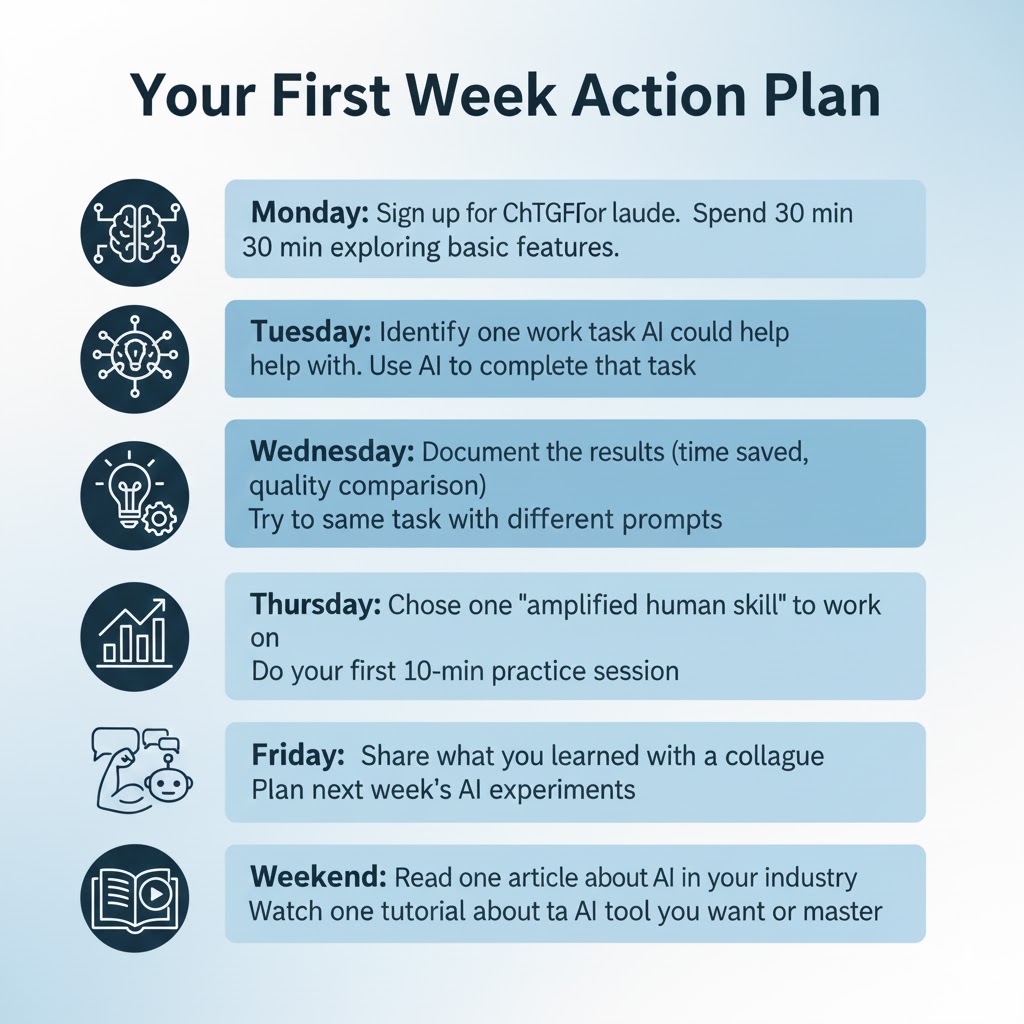
Your First Week Action Plan
Monday:
- Sign up for ChatGPT or Claude
- Spend 30 min exploring basic features
Tuesday:
- Identify one work task AI could help with
- Use AI to complete that task
Wednesday:
- Document the results (time saved, quality comparison)
- Try the same task with different prompts
Thursday:
- Choose one “amplified human skill” to work on
- Do your first 10-minute practice session
Friday:
- Share what you learned with a colleague
- Plan next week’s AI experiments
Weekend:
- Read one article about AI in your industry
- Watch one tutorial about an AI tool you want to master
Final Thoughts: The Learning Never Stops
AI is evolving rapidly. The skills you need today will expand tomorrow. But that’s not a bug—it’s a feature.
The most important skill isn’t any specific technical ability. It’s the commitment to continuous learning.
If you maintain curiosity, embrace experimentation, and stay adaptable, you’ll not only survive the AI transformation—you’ll thrive in it.
Start today. Start small. But start.
Your AI-augmented career begins now.
What’s Next?
Ready to dive deeper into specific AI tools? Check out our guide on [Mastering ChatGPT for Professional Use] or learn about [Prompt Engineering Techniques] to get more from AI tools.
Have questions about AI and your specific career? Leave a comment below or join our community discussions.
Remember: The goal isn’t to compete with AI. It’s to become irreplaceably good at working WITH AI.
Frequently Asked Questions: Generative AI and the Future of Work
These are the most common questions people ask about how generative AI will impact work and careers. Each answer is designed to give you clear, actionable information.
General Understanding
What is generative AI in the workplace?
Generative AI in the workplace refers to artificial intelligence systems that can create new content—including text, images, code, and data analysis—to assist with work tasks. Tools like ChatGPT, Claude, GitHub Copilot, and Midjourney are examples of generative AI that help employees with writing, coding, design, research, and problem-solving. Unlike traditional software that follows fixed rules, generative AI learns patterns from vast amounts of data and can produce novel outputs based on user prompts.
In practical terms, generative AI acts as a highly capable assistant that can draft emails, write reports, generate code, analyze data, create presentations, and handle repetitive tasks—allowing workers to focus on higher-value activities requiring human judgment, creativity, and emotional intelligence.
How does generative AI differ from other AI technologies?
Generative AI creates new content, while traditional AI classifies, predicts, or automates existing processes.
Traditional AI examples:
- Spam filters (classification)
- Netflix recommendations (prediction)
- Manufacturing robots (automation)
- Fraud detection systems (pattern recognition)
Generative AI examples:
- Writing entire articles from prompts
- Creating original images from descriptions
- Generating functional code from natural language
- Producing personalized marketing content
The key difference: Traditional AI analyzes and acts on existing data, while generative AI produces entirely new outputs. This makes generative AI particularly transformative for knowledge work, creative industries, and professional services.
Which industries will be most affected by generative AI?
Nearly every industry will be impacted, but these sectors face the most immediate transformation:
Highly Impacted (60-80% of tasks affected):
- Content Creation & Media: Writing, journalism, marketing, advertising
- Software Development: Code generation, testing, documentation
- Customer Service: Chatbots, support ticket handling, FAQs
- Legal Services: Contract review, legal research, document generation
- Financial Services: Analysis, reporting, fraud detection, advisory
Moderately Impacted (30-50% of tasks affected):
6. Healthcare: Diagnostics assistance, administrative tasks, research
7. Education: Personalized learning, content creation, and grading
8. Sales & Marketing: Lead generation, content creation, personalization
9. Human Resources: Recruiting, onboarding, training materials
10. Design: Graphic design, UI/UX, product design
Lower Impact (10-30% of tasks affected):
11. Skilled Trades: Electricians, plumbers, HVAC (hands-on work)
12. Healthcare Delivery: Nursing, physical therapy (patient care)
13. Hospitality: Restaurant service, hotel management (human touch)
14. Construction: Project management, planning (some admin tasks)
Industries requiring physical presence, hands-on skills, and deep human connection will see AI augmentation but not wholesale transformation.
Job Security & Displacement
Will generative AI replace human workers?
No, generative AI will not replace most human workers, but it will significantly change how we work. Research shows that AI is more likely to augment jobs (making humans more productive) rather than eliminate them entirely.
The data:
- World Economic Forum predicts 83 million jobs displaced but 69 million new jobs created by 2027 (net loss of only 14 million globally, offset by productivity gains)
- Most jobs are 30-50% automatable, not 100%
- Historical precedent: Technology has consistently created more jobs than it eliminates
What’s actually happening:
- Tasks are being automated, not entire jobs. A financial analyst might use AI for data analysis, but still needs human judgment for strategy
- Productivity increases lead to growth, which creates new roles
- New job categories emerge: Prompt engineers, AI trainers, AI ethics officers, human-AI interaction designers
Who’s most at risk:
- Entry-level positions with highly repetitive tasks
- Roles focused on information processing without judgment
- Jobs that don’t require specialized domain expertise
Who’s safe:
- Roles requiring complex human interaction
- Jobs demanding physical skills in unpredictable environments
- Positions needing ethical judgment and strategic thinking
- Work requiring deep domain expertise + AI literacy
Bottom line: Your job isn’t threatened by AI itself—it’s threatened by people who know how to use AI better than you do.
What jobs are safest from AI automation?
Jobs requiring uniquely human capabilities are safest. These involve complex social interaction, physical skills, creative problem-solving, and ethical judgment.
Safest Job Categories:
1. Healthcare Practitioners
- Doctors, surgeons, nurses, therapists
- Why: Hands-on care, empathy, real-time diagnosis, patient relationships
- AI role: Diagnostic assistance, not replacement
2. Skilled Trades
- Electricians, plumbers, HVAC technicians, mechanics
- Why: Physical work in unpredictable environments, problem-solving
- AI role: Minimal—may help with diagnostics or planning
3. Education & Training
- Teachers, professors, corporate trainers, coaches
- Why: Personalized instruction, motivation, mentorship, emotional support
- AI role: Content generation, grading assistance, but not teaching itself
4. Leadership & Management
- Executives, managers, team leaders
- Why: Strategic decision-making, people management, organizational politics
- AI role: Data analysis for decisions, but not the decisions themselves
5. Creative Directors & Strategists
- Creative directors, brand strategists, innovation leads
- Why: Original vision, taste, cultural understanding, risk-taking
- AI role: Generates options, humans direct and select
6. Therapists & Counselors
- Psychologists, social workers, and career counselors
- Why: Deep empathy, building trust, nuanced understanding of humans
- AI role: Note-taking, research, but not therapy itself
7. Legal Professionals (Senior)
- Judges, senior attorneys, mediators
- Why: Legal judgment, argumentation, negotiation, courtroom presence
- AI role: Research and document review, but not legal strategy
8. Entrepreneurship & Sales
- Business owners, sales leaders, relationship managers
- Why: Risk tolerance, relationship building, negotiation, persuasion
- AI role: Lead generation and research, but not relationship building
Common thread: These jobs require on-the-spot human judgment, physical presence, deep relationships, or navigation of complex social dynamics; areas where AI currently struggles.
What jobs will AI replace first?
AI will first impact jobs with high routine content, clear patterns, and digital workflows. These roles are already seeing significant automation.
High-Risk Jobs (70-90% automation potential in the next 5 years):
1. Data Entry Clerks
- Why: Purely repetitive, pattern-based work
- AI alternative: Automated data extraction and entry
- Timeline: Already happening
2. Telemarketing
- Why: Scripted conversations, high volume
- AI alternative: AI voice assistants and chatbots
- Timeline: 2-3 years for widespread adoption
3. Basic Content Writers
- Why: Formulaic writing (product descriptions, simple news)
- AI alternative: GPT-4, Claude for content generation
- Timeline: Already impacting freelance markets
4. Bookkeeping Clerks
- Why: Rule-based data processing
- AI alternative: Automated accounting software
- Timeline: Next 3-5 years
5. Assembly Line Workers (routine)
- Why: Repetitive physical tasks in controlled environments
- AI alternative: Industrial robots + AI coordination
- Timeline: Ongoing for decades
6. Customer Service Representatives (Tier 1)
- Why: Answering FAQs, basic troubleshooting
- AI alternative: Advanced chatbots like ChatGPT integrations
- Timeline: Already happening at scale
7. Proofreaders & Copy Editors (basic)
- Why: Grammar and style checking
- AI alternative: Grammarly, AI editing tools
- Timeline: Already widespread
8. Travel Agents (basic bookings)
- Why: Simple reservations and comparisons
- AI alternative: AI-powered booking platforms
- Timeline: Already largely automated
9. Loan Officers (routine)
- Why: Credit assessment following clear criteria
- AI alternative: Automated underwriting systems
- Timeline: Next 2-3 years
10. Paralegal Researchers
- Why: Legal document review and research
- AI alternative: AI legal research tools
- Timeline: 3-5 years for mainstream adoption
Important note: Even in these “high risk” categories, complex cases and relationship management will still require humans. The entry-level, high-volume, routine aspects will automate first.
How many jobs will AI create vs. eliminate?
AI will create approximately 69 million new jobs while eliminating 83 million by 2027, according to World Economic Forum research—a net loss of 14 million jobs globally (less than 1% of the global workforce).
However, this tells an incomplete story. Here’s the fuller picture:
Jobs Eliminated (83 million):
- Data entry and administrative roles (25 million)
- Routine customer service (15 million)
- Basic accounting and bookkeeping (12 million)
- Manufacturing and assembly (18 million)
- Other routine clerical work (13 million)
Jobs Created (69 million):
- AI and machine learning specialists (10 million)
- Data analysts and scientists (8 million)
- Digital marketing specialists (7 million)
- Software developers (9 million)
- Information security analysts (6 million)
- AI trainers and explainers (5 million)
- Human-AI interaction designers (4 million)
- Business intelligence analysts (6 million)
- Process automation specialists (5 million)
- Other emerging tech roles (9 million)
Why this matters:
- Quality vs. quantity: New jobs typically pay better than eliminated ones
- Skills gap: The challenge is retraining, not total job shortage
- Geographic mismatch: New jobs may not be where old jobs disappear
- Timeline: Disruption happens faster than job creation
Historical context:
- 1800s: Industrial Revolution eliminated farm jobs, created factory jobs (net gain)
- 1980s: Computers eliminated clerical jobs, created tech jobs (massive net gain)
- 2000s: Internet eliminated retail jobs, created digital jobs (net gain)
- 2020s: AI eliminating routine jobs, creating AI-related jobs (expected net gain long-term)
The real question isn’t “Will there be enough jobs?” It’s “Will workers have the skills for new jobs and will transition happen smoothly?”
Skills & Preparation
What skills do I need to work with AI?
You need a combination of technical AI literacy, amplified human skills, and adaptive capabilities. Here’s the priority order:
Tier 1: Essential for Everyone (Start Here)
- Basic AI Tool Proficiency
- How to use ChatGPT, Claude, or similar tools
- Understanding when to use AI vs. doing tasks manually
- Basic prompt engineering (asking AI effectively)
- Time to learn: 2-4 weeks
- Critical Evaluation of AI Outputs
- Fact-checking AI-generated content
- Recognizing AI biases and limitations
- Verifying accuracy before using AI work
- Time to learn: Ongoing practice
- AI-Augmented Workflows
- Integrating AI into your current job
- Identifying which tasks benefit from AI
- Measuring productivity improvements
- Time to learn: 1-2 months
Tier 2: Human Skills That AI Amplifies
- Emotional Intelligence
- Reading social cues and emotions
- Building genuine relationships
- Navigating interpersonal conflict
- Providing authentic empathy
- Creative Problem-Solving
- Thinking outside established patterns
- Connecting unrelated concepts
- Generating truly novel solutions
- Strategic Thinking
- Long-term planning and vision
- Weighing complex trade-offs
- Making decisions with incomplete information
- Complex Communication
- Persuasion and negotiation
- Storytelling and presentation
- Adapting communication to the audience
Tier 3: Advanced AI Skills (Career Differentiators)
- Prompt Engineering Mastery
- Chain-of-thought prompting
- Few-shot learning techniques
- Combining multiple AI tools
- Time to learn: 3-6 months
- AI Ethics & Governance
- Understanding AI bias and fairness
- Privacy and data considerations
- Responsible AI deployment
- Time to learn: Ongoing
- Domain Expertise + AI
- Deep knowledge in your field
- Ability to direct AI with expert judgment
- Recognizing when AI gets domain-specific things wrong
- Time to learn: Years (but you likely have domain expertise already)
Quick Start Recommendation:
- Week 1-4: Master ChatGPT or Claude for daily tasks
- Month 2-3: Develop one human skill (EQ, creativity, or communication)
- Month 4-6: Learn intermediate prompt engineering
- Ongoing: Stay current on AI developments in your industry
Remember: You don’t need to become a machine learning engineer. You need to become excellent at directing AI to amplify your work.
How can I prepare for AI in my workplace?
Preparing for AI requires both skill development and strategic positioning. Here’s a practical action plan:
Phase 1: Immediate Actions (This Week)
- Start Using AI Tools Daily
- Sign up for ChatGPT, Claude, or similar (free versions work)
- Use AI for at least one work task per day
- Document time saved and quality of outputs
- Identify Your Irreplaceable Value
- List tasks only you (or a human) can do in your role
- Identify your unique expertise or relationships
- Focus development on these areas
- Assess Your Current Role’s AI Exposure
- What percentage of your tasks could AI handle?
- Which specific tasks are most vulnerable?
- Where do you add human judgment?
Phase 2: First 30 Days
- Formal AI Education
- Take free course: “AI for Everyone” (Coursera)
- Watch tutorials on AI tools in your industry
- Join AI communities (Reddit, Discord, LinkedIn groups)
- Experiment Systematically
- Week 1: Writing tasks (emails, reports, drafts)
- Week 2: Analysis tasks (data, research, summaries)
- Week 3: Creative tasks (brainstorming, problem-solving)
- Week 4: Specialized tasks (industry-specific applications)
- Measure and Document
- Track hours saved per week
- Note quality improvements or issues
- Build a portfolio of AI-assisted work
Phase 3: First 90 Days
- Position Yourself as the “AI Person”
- Share AI tips with colleagues
- Volunteer for AI-related projects
- Demonstrate productivity improvements
- Become the go-to person for AI questions
- Upskill Strategically
- Choose one human skill to develop (communication, creativity, strategy)
- Take advanced AI tool training
- Learn industry-specific AI applications
- Network with AI Practitioners
- Attend AI webinars and conferences
- Connect with AI professionals on LinkedIn
- Join AI user groups in your city
Phase 4: Long-term Strategy (6-12 Months)
- Reshape Your Role
- Propose AI-enhanced workflows to management
- Automate routine parts of your job
- Focus time on high-value, human-centric tasks
- Build new skills that complement AI
- Demonstrate ROI
- Present data on productivity improvements
- Show cost savings from AI automation
- Highlight quality improvements
- Position yourself as an innovation driver
- Consider Career Pivots
- If your role is high-risk, explore adjacent fields
- Transition toward strategic/relationship roles
- Consider AI-focused career paths
- Build skills for emerging AI-related positions
Industry-Specific Advice:
If you’re in Marketing:
- Master AI content tools (Jasper, Copy.ai)
- Focus on strategy and brand voice (human skills)
- Learn AI-powered analytics platforms
If you’re in Software Development:
- Adopt GitHub Copilot or Cursor immediately
- Focus on architecture and system design
- Become an expert at code review of AI outputs
If you’re in Finance:
- Learn AI-powered financial modeling tools
- Develop client advisory skills (relationship-based)
- Focus on strategic planning vs. data processing
If you’re in Healthcare:
- Understand AI diagnostic assistance tools
- Emphasize patient care and bedside manner
- Learn to interpret and validate AI recommendations
If you’re in Education:
- Integrate AI into lesson planning
- Develop personalized learning with AI
- Focus on mentorship and emotional support
Red Flags—Don’t Do This:
- Ignore AI, hoping it goes away
- Resist AI adoption at your organization. Refuse to learn new tools
- Assume your expertise alone protects you
- Wait for your employer to train you
Green Flags—Success Behaviors:
- Proactive experimentation
- Sharing knowledge with others
- Documenting productivity gains
- Volunteering for AI initiatives
- Continuous learning mindset
Bottom line: The workers who thrive won’t be those who fight AI or ignore it—they’ll be those who learn to direct AI effectively while developing irreplaceable human skills.
Business Implementation
How are companies currently using generative AI?
Companies are implementing generative AI across nearly every business function, with adoption accelerating rapidly in 2024-2025. Here are the most common current applications:
Content Creation & Marketing (85% of companies)
- Blog posts and article writing
- Social media content generation
- Email marketing campaigns
- Product descriptions and SEO content
- Ad copy and creative variations
- Marketing strategy brainstorming
Customer Service (72% of companies)
- AI chatbots for tier-1 support
- Automated email responses
- FAQ generation and maintenance
- Call center assistance (real-time agent guidance)
- Sentiment analysis of customer feedback
- Multilingual support
Software Development (68% of tech companies)
- Code generation and completion (GitHub Copilot)
- Automated testing and debugging
- Documentation writing
- Code review assistance
- Legacy code modernization
- API integration suggestions
Data Analysis & Business Intelligence (61% of companies)
- Report generation from raw data
- Data visualization recommendations
- Trend identification and pattern recognition
- Predictive analytics
- Natural language database queries
- Executive summary creation
Internal Communications (58% of companies)
- Email drafting and responses
- Meeting summaries and action items
- Internal documentation
- Policy and procedure writing
- Employee onboarding materials
- Training content development
Human Resources (54% of companies)
- Job description writing
- Resume screening and initial candidate assessment
- Interview question generation
- Employee performance review drafting
- Training material creation
- Benefits communication
Sales & Lead Generation (51% of companies)
- Personalized outreach emails
- Proposal and pitch deck creation
- Lead qualification and scoring
- Sales script development
- Competitive analysis
- Account research automation
Research & Development (45% of companies)
- Literature review and synthesis
- Research proposal writing
- Experimental design suggestions
- Patent research
- Technical documentation
- Data pattern discovery
Design & Creative (42% of companies)
- Image generation for concepts and mockups
- UI/UX design suggestions
- Presentation design
- Brand asset variations
- Video script writing
- Storyboarding
Finance & Accounting (39% of companies)
- Financial report generation
- Budget analysis and forecasting
- Anomaly detection in financial data
- Invoice processing
- Expense categorization
- Audit support documentation
Real Company Examples:
Salesforce: Uses AI (Einstein GPT) to automatically generate personalized customer emails, saving sales teams 5+ hours per week per rep.
Microsoft: GitHub Copilot used by 27,000+ organizations, with developers reporting 55% faster code completion.
Duolingo: Uses GPT-4 to create personalized language learning experiences and conversation practice.
Morgan Stanley: Deployed GPT-4 to help financial advisors quickly search and synthesize information from 100,000+ research documents.
Coca-Cola: Uses generative AI (DALL-E) for creative advertising concepts and personalized marketing campaigns.
Adoption Statistics:
- 60% of companies have at least one AI project in production (Gartner)
- 94% of business leaders believe AI is critical to success (IBM)
- Average ROI: $3.70 returned for every $1 invested in generative AI (Accenture)
- Implementation timeline: 3-6 months from pilot to production average
What is the ROI of implementing generative AI?
Companies implementing generative AI are seeing significant returns, with most reporting positive ROI within 6-12 months. Here’s the data:
Average Financial Returns:
- $3.70 return per $1 invested (Accenture global study)
- 20-40% cost reduction in content production
- 30-50% time savings on routine knowledge work
- 15-25% revenue increase from improved personalization and speed
ROI by Use Case:
Content Creation:
- Investment: $5,000-50,000 (tools + training)
- Savings: $100,000-500,000 annually (reduced freelance costs, increased output)
- ROI: 200-1000% in year one
- Payback period: 1-3 months
Customer Service:
- Investment: $50,000-200,000 (chatbot implementation)
- Savings: $300,000-1.5M annually (reduced headcount, 24/7 availability, faster resolution)
- ROI: 300-600% in year one
- Payback period: 2-4 months
Software Development:
- Investment: $20,000-100,000 (tools + training)
- Savings: $500,000-2M annually (faster development, reduced bugs, smaller teams)
- ROI: 500-2000% in year one
- Payback period: 1-2 months
Data Analysis:
- Investment: $30,000-150,000
- Savings: $200,000-800,000 annually (faster insights, reduced analyst time)
- ROI: 300-500% in year one
- Payback period: 2-3 months
Productivity Metrics:
Writing & Communication:
- 3-5x faster draft creation
- 40-60% reduction in revision cycles
- 70% of employees report quality equal to or better than manual work
Coding:
- 55% faster code completion (GitHub Copilot data)
- 40% reduction in debugging time
- 2x more features shipped per sprint
Research & Analysis:
- 60-80% faster information gathering
- 50% reduction in time to insight
- Ability to analyze 10x more sources
Customer Service:
- 40-60% of tier-1 tickets automated
- 30% reduction in average resolution time
- 25% improvement in customer satisfaction scores
Intangible Benefits:
- Employee satisfaction (workers prefer AI-augmented roles)
- Faster time-to-market for products
- Improved consistency in outputs
- 24/7 capability without overtime costs
- Scalability without proportional headcount increases
Cost Breakdown:
Initial Investment:
- Software tools: $1,000-100,000 annually (depending on scale)
- Training: $5,000-50,000 (one-time)
- Implementation consulting: $10,000-200,000 (optional)
- Change management: $10,000-100,000
Ongoing Costs:
- API usage: $500-50,000 monthly (scales with usage)
- Maintenance: $1,000-20,000 monthly
- Continuous training: $2,000-20,000 annually
ROI Timeline:
Months 1-3: Experimentation, training, pilots (cost center)
Months 4-6: Initial productivity gains visible (approaching break-even)
Months 7-12: Significant ROI realized (200-400% returns typical)
Year 2+: Compounding benefits (500-1000%+ cumulative returns)
Factors Affecting ROI:
Higher ROI scenarios:
- Clear, repetitive use cases
- High-volume operations
- Knowledge work that’s currently manual
- Strong change management
- Employee buy-in and training
Lower ROI scenarios:
- Poorly defined use cases
- Expecting AI to work without human oversight
- Inadequate training
- Resistance to change
- Highly specialized niche domains with limited training data
Real Company ROI Examples:
Instacart: 40% increase in search-to-purchase conversion using AI-powered recommendations (millions in additional revenue)
Duolingo: 10% improvement in user engagement, translating to $50M+ annual revenue impact
Moderna: Reduced time to develop clinical trial documents from weeks to days, saving $2M+ annually
Bottom line: For most companies, the ROI question isn’t “if” but “how fast” they can realize returns. Early adopters with clear use cases and strong implementation are seeing 300-500% ROI within the first year.
Concerns & Challenges
What are the biggest risks of generative AI?
Generative AI presents several significant risks that individuals, companies, and society must address:
1. Misinformation & Hallucinations
The Risk: AI confidently generates false information that sounds plausible.
Examples:
- ChatGPT invents non-existent legal cases that lawyers cited in court
- AI is creating fake research citations
- Generating plausible-sounding but incorrect medical information
Mitigation:
- Always verify AI-generated facts
- Use AI for drafts, not final outputs without review
- Implement human review processes
- Cross-reference critical information
2. Bias & Discrimination
The Risk: AI perpetuates and amplifies societal biases from training data.
Examples:
- Resume screening AI favors male candidates
- Facial recognition is performing poorly on darker skin tones
- Language models generating stereotyped content
Mitigation:
- Diverse training data
- Regular bias audits
- Human oversight for decisions affecting people
- Transparency about AI limitations
3. Privacy & Data Security
The Risk: Sensitive information shared with AI tools may be stored or leaked.
Examples:
- Employees sharing proprietary data with public AI tools
- Customer information inadvertently included in prompts
- AI training on confidential data
Mitigation:
- Clear AI usage policies
- Enterprise AI solutions with data privacy guarantees
- Employee training on what not to share
- Data anonymization practices
4. Job Displacement & Economic Disruption
The Risk: Rapid automation without adequate support for affected workers during transition.
Examples:
- Mass layoffs in customer service and content writing
- Geographic communities dependent on automatable jobs
- Skills gaps are preventing workers from transitioning
Mitigation:
- Retraining programs
- Social safety nets
- Gradual implementation with transition planning
- Focus on AI augmentation over replacement
5. Intellectual Property Violations
The Risk: AI trained on copyrighted material may reproduce protected content.
Examples:
- AI-generated images closely resembling copyrighted artwork
- Code completion tools reproducing licensed code
- Content generation using proprietary writing styles
Mitigation:
- Legal frameworks for AI training data
- Output filtering for copyright violations
- Clear policies on AI-generated content ownership
- Proper attribution and licensing
6. Dependency & Deskilling
The Risk: Over-reliance on AI erodes human capabilities.
Examples:
- Writers are losing the ability to craft content without AI
- Programmers are unable to code without AI assistance
- Students are not developing critical thinking skills
Mitigation:
- Use AI as a tool, not a crutch
- Maintain core skills through regular practice
- Educational approaches that balance AI use with skill development
- Periodic “AI-free” work to maintain capabilities
7. Manipulation & Deepfakes
The Risk: AI enables unprecedented deception at scale.
Examples:
- Deepfake videos of public figures
- AI-generated phishing emails personalized at scale
- Fake news and propaganda automation
- Voice cloning for fraud
Mitigation:
- Digital watermarking and authentication
- Media literacy education
- Detection technologies
- Legal consequences for malicious use
8. Lack of Accountability
The Risk: Unclear who’s responsible when AI makes mistakes.
Examples:
- AI medical misdiagnosis—doctor or AI company liable?
- AI-generated defamatory content—who’s sued?
- Autonomous vehicle accidents
Mitigation:
- Clear legal frameworks
- Human-in-the-loop for critical decisions
- Audit trails for AI decision-making
- Insurance and liability models
9. Environmental Impact
The Risk: Training and running AI requires massive energy consumption.
Examples:
- GPT-4 training used equivalent electricity to power 1,000 homes for a year
- Data centers’ carbon footprint is increasing
- Water usage for cooling AI infrastructure
Mitigation:
- Energy-efficient AI architectures
- Renewable energy for data centers
- Smaller, specialized models instead of massive general ones
- Carbon accounting and offsetting
10. Existential & Control Risks
The Risk: Advanced AI systems becoming difficult to control or align with human values.
Examples:
- AI optimizing for the wrong objectives
- Unintended consequences at scale
- Loss of human oversight ability
Mitigation:
- AI safety research
- Robust testing before deployment
- Kill switches and oversight mechanisms
- International cooperation on AI governance
Risk Management Framework:
Individual Level:
- Verify all AI outputs
- Protect personal data
- Maintain human skills
- Stay informed about AI developments
Company Level:
- Clear AI usage policies
- Regular audits for bias and errors
- Employee training
- Ethical AI guidelines
- Incident response plans
Societal Level:
- Regulatory frameworks
- AI education in schools
- Social safety nets for displaced workers
- International cooperation on AI governance
Bottom line: These risks are real and significant, but manageable with proper safeguards, education, and governance. The key is proactive risk management, not rejection of the technology.
How do I ensure AI doesn’t introduce bias in my work?
Preventing and mitigating AI bias requires awareness, processes, and vigilance. Here’s a practical approach:
Step 1: Understand Common AI Biases
Types of bias:
- Training data bias: AI learns from biased data (e.g., historical hiring favoring certain demographics)
- Selection bias: The Data doesn’t represent the full population
- Confirmation bias: AI reflects users’ existing assumptions
- Label bias: Human labelers’ prejudices in training data
- Algorithmic bias: Model architecture amplifies certain patterns
Step 2: Detection Strategies
How to spot bias in AI outputs:
- Demographic testing: Run the same prompt with different demographic indicators
- Example: “Recommend a candidate named [Muhammad/John] with [same qualifications]”
- Check if outputs differ
- Edge case testing: Test AI on underrepresented groups
- Does medical AI work equally well for all ethnicities?
- Does hiring AI evaluate non-traditional backgrounds fairly?
- Compare multiple sources:
- Run the same prompt across ChatGPT, Claude, and Gemini.
- Differences may reveal biases
- Statistical analysis:
- If using AI for repeated decisions, analyze outcomes by demographic
- Look for disparate impact
- Red teaming:
- Actively try to expose biases
- Test controversial topics
- Check for stereotyped outputs
Step 3: Mitigation Techniques
When using AI in your work:
- Explicit instructions about fairness:
- “Evaluate these candidates based solely on qualifications, skills, and experience.
- Do not consider age, gender, ethnicity, or other protected characteristics.
- Explain your reasoning to ensure fairness.”
- Diverse examples in prompts (few-shot learning):
- If providing examples, ensure they’re diverse
- Include underrepresented groups in your examples
- Human review of AI decisions:
- Never use AI for automated decisions affecting people
- Always have human oversight
- Multiple reviewers for high-stakes decisions
- Disaggregated analysis:
- Break down AI outputs by relevant categories
- Check if certain groups are systematically treated differently
- Transparency:
- Disclose when AI is used in decisions
- Provide the ability to appeal AI-influenced decisions
- Explain how AI factors into decisions
- Regular audits:
- Quarterly review of AI-assisted decisions
- Look for patterns suggesting bias
- Adjust processes if bias is detected
Step 4: Context-Specific Approaches
For hiring and HR:
- Remove demographic information before AI analysis
- Use standardized evaluation criteria
- Have a diverse panel review AI recommendations
- Track hiring outcomes by demographics
- Regular bias audits of AI tools
Frequently Asked Questions (FAQs):
Deep research is a comprehensive, systematic approach to investigating a topic that goes far beyond surface-level information gathering. While regular research might involve reading a few articles or conducting a quick Google search, deep research requires extensive exploration across multiple sources, critical evaluation of evidence, synthesis of diverse perspectives, and rigorous documentation of findings. Regular research uses 3-5 sources and takes hours to days, while deep research uses 20-50+ sources and takes weeks to months. Deep research is essential for academic work, professional analysis, investigative journalism, policy development, and any situation where accuracy and comprehensive understanding are critical.
Use deep research when high-stakes decisions depend on your findings (business strategy, investment decisions, policy recommendations), when you need original insights for academic work or competitive analysis, when the topic is complex or controversial with multiple competing viewpoints, when accuracy is critical for published work or professional reports, or when you’re establishing yourself as an authority in your field. Use quick research for personal curiosity questions, time-sensitive decisions with acceptable uncertainty, preliminary exploration, or low-stakes situations where good enough suffices.
Deep research timelines vary based on topic complexity. Quick deep research takes 1-2 weeks for well-documented topics. Standard deep research takes 1-3 months for moderately complex topics requiring synthesis across disciplines. Extensive deep research takes 3-6 months for complex topics requiring primary research. Major research projects take 6-12+ months for novel topics with limited existing research. Time breakdown by phase: question formulation and planning (5-10%), information gathering (40-50%), analysis and synthesis (25-30%), documentation and writing (15-20%), and review and revision (5-10%). Most researchers underestimate time requirements by 50-100%, so build in buffer time.
A strong research question follows the FINER criteria: Feasible (can you answer it with available resources), Interesting (does it matter to you and your audience), Novel (does it add something new), Ethical (can you research it without causing harm), and Relevant (does it address an important issue). Start broad with your general interest, add specificity to narrow the topic, make it researchable with concrete parameters, and refine based on initial research. Good questions are descriptive (what is happening), explanatory (why is this happening), predictive (what will happen), or prescriptive (what should be done). Start with descriptive questions, then move to explanatory or prescriptive as your understanding deepens.
Essential tools include research databases (Google Scholar, JSTOR, PubMed for academic sources), reference management software (Zotero or Mendeley for citation management and PDF organization), note-taking systems (Notion or Obsidian for organizing research notes), and writing tools (Google Docs for collaboration). AI research assistants like ChatGPT or Claude can help with literature synthesis and analysis. A minimum toolkit to start includes Google Scholar for search, Zotero for reference management, Notion or Obsidian for notes, Google Docs for writing, and an AI assistant for synthesis. Total cost ranges from $0-20 per month. Additional specialized tools include NVivo for qualitative analysis and various academic databases depending on your field.
A structured research plan includes five phases: Foundation (weeks 1-2) for preliminary literature review and setting up tools, Data Collection (weeks 3-6) for academic database searches and expert interviews, Analysis (weeks 7-8) for coding findings and identifying patterns, Documentation (weeks 9-10) for drafting reports and creating visualizations, and Finalization (weeks 11-12) for peer review and final revisions. Define your research question, identify sub-questions, determine what done looks like, conduct preliminary research, develop a search strategy, create an information architecture for organizing sources, set timeline and milestones, and identify resources and constraints. Review and adjust your plan every 2 weeks as research rarely goes exactly as planned.
Use the CRAAP test to evaluate sources: Currency (is the information current and updated), Relevance (does it fit your needs and answer your research question), Authority (is the author credible with proper credentials), Accuracy (is the information correct and supported by evidence), and Purpose (why was this created – to inform, persuade, sell). Strong positive signals include peer-reviewed academic journals, citations from other credible sources, transparent methodology, disclosed conflicts of interest, and established institutional publishers. Red flags include sensationalist headlines, no author listed, lack of citations, obvious bias without acknowledgment, poor grammar, extraordinary claims without evidence, and masked commercial motivation. When in doubt, ask yourself: Would I stake my reputation on this source?
Source requirements vary by research type: blog posts need 10-15 sources, undergraduate papers need 15-25 sources, master’s theses need 50-100+ sources, PhD dissertations need 100-300+ sources, professional reports need 20-50 sources, and books need 100-500+ sources. However, quality matters more than quantity. You know you have enough sources when you start seeing the same sources cited repeatedly, new sources aren’t adding new information, you can identify different schools of thought, you encounter the same arguments from multiple angles, and you’ve identified key debates and controversies. Ensure source diversity, including academic papers, books, government reports, industry reports, expert interviews, primary sources, news articles, international perspectives, and opposing viewpoints.
Primary research is research you conduct yourself, gathering original data directly from sources through surveys, interviews, focus groups, experiments, observations, or case studies. It addresses your specific question directly and provides an original contribution to knowledge, but it is time-intensive and expensive. Secondary research is the analysis of existing data and information gathered by others, including literature reviews, analysis of published research, meta-analysis, and review of government statistics. It is faster and less expensive, can access large datasets, but may not perfectly fit your question, and the quality depends on the original research. Best practice is to combine both: start with secondary research to understand the landscape and identify gaps, then conduct primary research to address those gaps or test specific hypotheses.
An effective organization requires a multi-component system. Use reference management software (Zotero, Mendeley) to store PDFs, generate citations, and tag sources by theme. Implement the Zettelkasten method for note-taking: create atomic notes with one idea per note, link related notes together, add your own thoughts, not just summaries, and build a knowledge network. Create a folder structure organizing Planning, Sources, Notes, Analysis, Writing, and Data. Maintain a tracking spreadsheet with columns for title, author, year, source type, key themes, relevance rating, and status. Create synthesis documents, including literature review matrices, theme trackers, timelines, and concept maps. Best practices include consistent naming conventions, regular backups, processing information immediately while reading, and weekly 30-minute review sessions to connect notes.
Combat information overload by setting clear scope boundaries defining what’s in and out of scope, using progressive depth (skim 30-50 sources, read carefully 15-25 most relevant, deeply analyze 5-10 most important), implementing filtering systems with quick assessment criteria, taking strategic notes focused on ideas that challenge assumptions and novel methodologies, conducting regular weekly synthesis sessions to identify themes and connections, using the information saturation principle to know when to stop researching a sub-topic, creating visual mind maps or concept maps, and managing physical and digital workspace organization. When already overwhelmed, do an emergency reset: stop gathering new information for 24-48 hours, review what you have, create a simple outline of what you know, identify the biggest gaps, and restart with a focused search for gaps only. Remember that perfect information is impossible and good research requires knowing when you have enough.
Related Articles:
100+ ChatGPT Prompts for Professionals

Recent Comments