
70 Advanced ChatGPT Prompts for Professionals – Part 2 [2026]
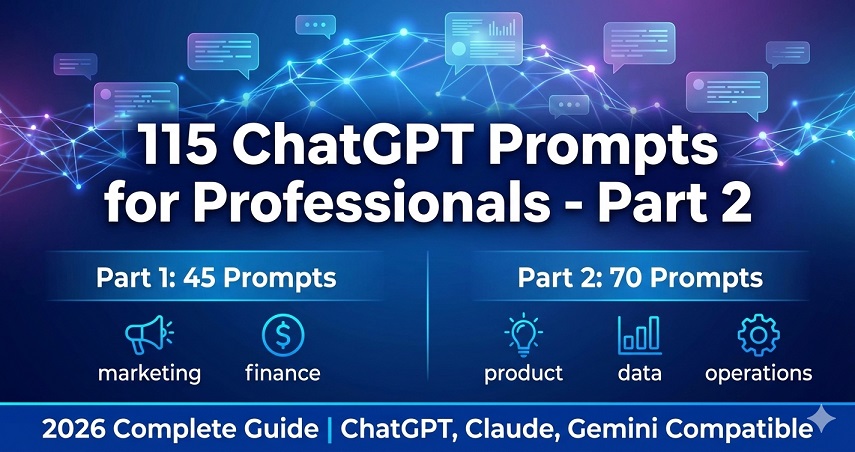
Welcome to Part 2 of our comprehensive ChatGPT prompts library! If you’ve mastered the first 45 prompts, you’re ready to unlock even more powerful AI capabilities. This guide delivers 70 additional professional prompts across multiple business functions, bringing your total arsenal to 115 ready-to-use templates.
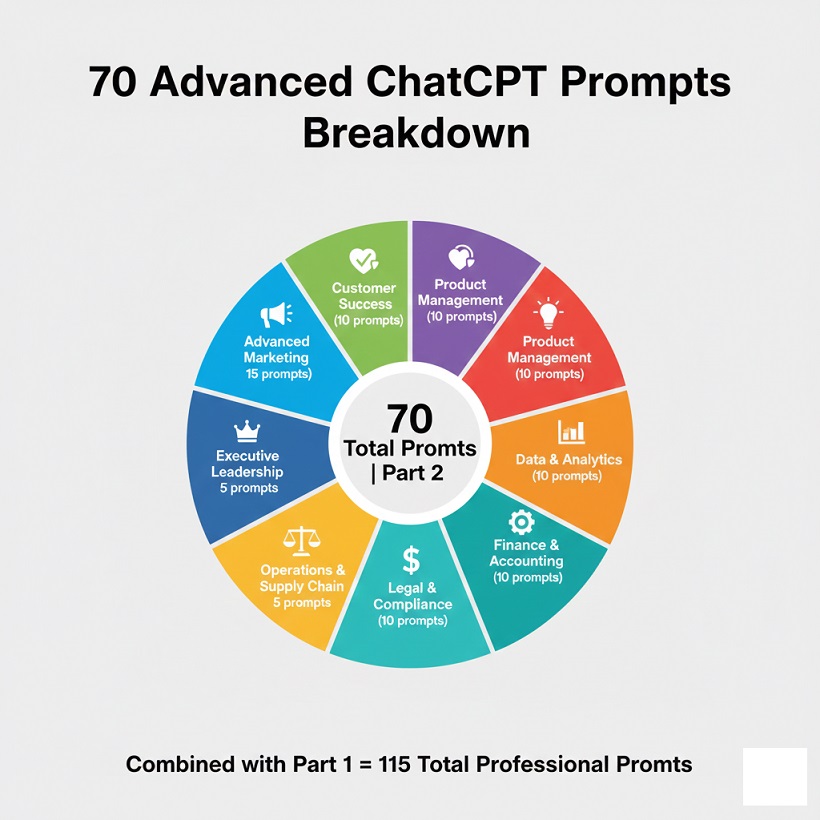
Table of Contents
• Advanced Marketing Prompts (46-60)
• Customer Success & Support (61-70)
• Product Management (71-80)
• Data Analysis & Business Intelligence (81-90)
• Finance & Accounting (91-100)
• Legal & Compliance (101-105)
• Operations & Supply Chain (106-110)
• Executive Leadership (111-115)
Advanced Marketing Prompts (46-60)
Prompt 46: Video Marketing Script Generator
Create a video marketing script for [product/service] targeting [audience]. The video should be [duration] long and include:- Hook (first 5 seconds)- Problem identification- Solution presentation- Social proof- Clear CTATone: [professional/casual/humorous]Platform: [YouTube/Instagram/TikTok/LinkedIn]Use Case: Content creators, video marketers, social media managers planning video campaigns.
Pro Tip: Specify the exact platform for optimized formatting and pacing tailored to each social media algorithm.
Prompt 47: Customer Persona Deep Dive
Develop a detailed customer persona for [product/service] including:- Demographics (age, location, income, education)- Psychographics (values, interests, lifestyle)- Pain points and challenges- Goals and aspirations- Buying behavior and decision factors- Preferred communication channels- Content consumption habits- Objections to purchaseBased on: [industry data/existing customer insights]Use Case: Marketing strategists, product teams, sales departments building targeted campaigns.
Pro Tip: Create multiple personas for different customer segments to refine your marketing approach.
Prompt 48: Conversion Rate Optimization (CRO) Audit
Analyze this landing page/website for conversion optimization:[URL or description]Provide specific recommendations for:- Headline and copy improvements- CTA placement and wording- Visual hierarchy- Trust signals and social proof- Form optimization- Mobile responsiveness- Page load speed considerations- A/B testing suggestionsIndustry: [your industry]Target conversion: [sign-up/purchase/download]Use Case: Digital marketers, UX designers, growth hackers improving website performance.
Pro Tip: Implement changes incrementally and track results to identify highest-impact optimizations.
Prompt 49: Influencer Campaign Strategy
Design an influencer marketing campaign for [product/service]:Campaign objectives: [brand awareness/sales/engagement]Budget: [amount]Target audience: [description]Campaign duration: [timeframe]Include:- Ideal influencer profile and criteria- Outreach message template- Campaign brief and deliverables- Content guidelines and hashtags- Performance metrics and KPIs- Contract key points- Timeline and milestonesUse Case: Brand managers, social media marketers, PR professionals.
Pro Tip: Focus on micro-influencers (10K-100K followers) for better engagement rates and authenticity.
Prompt 50: Marketing Automation Workflow
Create a marketing automation workflow for [customer journey stage]:Trigger: [action/behavior]Goal: [desired outcome]Duration: [timeframe]Design a sequence including:- Email series (subject lines and content outline)- Timing between messages- Segmentation criteria- Personalization elements- Decision points and branching logic- Success metrics- Exit criteriaTools available: [email platform/CRM]Use Case: Marketing automation specialists, email marketers, CRM managers.
Pro Tip: Map workflows to specific customer behaviors rather than time-based sequences for better relevance.
Prompt 51: SEO Content Cluster Strategy
Develop a content cluster strategy for the pillar topic: [main keyword/topic]Include:- Pillar page outline (comprehensive guide)- 10-15 cluster content topics- Target keywords for each piece- Internal linking strategy- Content format recommendations (blog/video/infographic)- Search intent for each topic- Competition analysis- Content calendar timelineIndustry: [your industry]Target audience: [description]Use Case: SEO specialists, content strategists, digital marketing managers.
Pro Tip: Start with the pillar page, then create cluster content systematically to build topical authority.
Prompt 52: Viral Social Media Campaign
Create a viral social media campaign concept for [brand/product]:Campaign theme: [topic/trend]Platforms: [specific social networks]Target audience: [demographics and interests]Develop:- Campaign name and hashtag- Core message and storytelling angle- User-generated content strategy- Engagement mechanics (contest/challenge)- Launch strategy and timeline- Influencer/partner involvement- Content templates and examples- Measurement frameworkUse Case: Social media managers, brand strategists, creative directors.
Pro Tip: Tap into current trends and emotions while staying authentic to your brand values.
Prompt 53: Retargeting Ad Campaign
Design a retargeting campaign for [website visitors who didn't convert]:Audience segment: [specific behavior/page visited]Platform: [Facebook/Google/LinkedIn]Budget: [amount]Campaign duration: [timeframe]Create:- Ad creative concepts (3 variations)- Ad copy for each variation- Targeting parameters- Bidding strategy- Landing page recommendations- Offer/incentive structure- Frequency cap guidelines- Performance benchmarksUse Case: PPC specialists, performance marketers, e-commerce managers.
Pro Tip: Segment retargeting audiences by engagement level for more personalized messaging.
Prompt 54: Brand Positioning Statement
Craft a brand positioning statement for [company/product]:Target audience: [who]Market category: [what industry]Key competitors: [list]Unique value proposition: [what makes you different]Create:- Positioning statement (1-2 sentences)- Supporting proof points- Messaging framework- Brand personality traits- Communication guidelines- Competitive differentiation matrix- Use cases and applicationsUse Case: Brand managers, marketing directors, startup founders.
Pro Tip: Test your positioning statement with real customers to ensure clarity and resonance.
Prompt 55: Customer Journey Map
Create a detailed customer journey map for [product/service]:Customer type: [persona]Journey start: [awareness stage]Journey end: [loyalty/advocacy]Map each stage including:- Customer actions and behaviors- Touchpoints (online and offline)- Emotions and pain points- Questions and concerns- Marketing activities- Optimization opportunities- Metrics to trackInclude: Awareness → Consideration → Decision → Purchase → Retention → AdvocacyUse Case: Customer experience managers, marketing strategists, UX researchers.
Pro Tip: Use actual customer data and interviews to validate your journey map assumptions.
Prompt 56: Product Launch Marketing Plan
Develop a comprehensive product launch marketing plan for [product name]:Launch date: [date]Product description: [details]Target market: [audience]Budget: [amount]Create plan covering:- Pre-launch strategy (2-3 months before)- Launch week tactics- Post-launch sustaining activities- Channel mix and tactics- Content calendar- PR and media outreach- Partnerships and collaborations- Launch events/webinars- KPIs and success metrics- Risk mitigation strategiesUse Case: Product marketers, launch managers, CMOs.
Pro Tip: Build anticipation with a teaser campaign 6-8 weeks before launch.
Prompt 57: Referral Program Strategy
Design a customer referral program for [business type]:Current customer base: [size and characteristics]Goal: [number of referrals/revenue target]Incentive budget: [amount]Develop:- Referral incentive structure (for referrer and referee)- Program mechanics and rules- Referral tracking system requirements- Marketing materials and templates- Promotional strategy- Email/SMS campaigns- Success metrics and ROI calculation- Program optimization planUse Case: Growth marketers, customer success managers, retention specialists.
Pro Tip: Offer dual-sided incentives (rewards for both referrer and referred) to maximize participation.
Prompt 58: Marketing Budget Allocation
Create an optimized marketing budget allocation for [business/department]:Total budget: [amount]Business goals: [list]Current channels: [existing marketing activities]Target audience: [description]Industry: [sector]Company stage: [startup/growth/mature]Provide:- Channel-by-channel breakdown with percentages- Rationale for each allocation- Expected ROI per channel- Testing/experimentation budget- Quarterly adjustment recommendations- Tools and technology costs- Contingency budget- Benchmarks vs. industry standardsUse Case: CMOs, marketing directors, and budget planners.
Pro Tip: Allocate 10-20% of the budget for testing new channels and tactics.
Prompt 59: Marketing Performance Dashboard
Design a marketing performance dashboard for [company/department]:Business objectives: [list]Team size: [number]Reporting frequency: [daily/weekly/monthly]Stakeholders: [who views this]Include metrics for:- Lead generation (volume, quality, cost)- Website performance (traffic, conversions, engagement)- Campaign performance (ROI, ROAS, CAC)- Content performance (engagement, shares, SEO ranking)- Social media (followers, engagement rate, reach)- Email marketing (open rate, CTR, conversions)- Sales pipeline contribution- Data visualization recommendations- Actionable insights formatUse Case: Marketing analysts, CMOs, performance marketers.
Pro Tip: Focus on actionable metrics rather than vanity metrics to drive real business decisions.
Prompt 60: Competitive Marketing Analysis
Conduct a competitive marketing analysis for [your company] vs. [competitors]:Competitors: [list 3-5 main competitors]Analysis timeframe: [period]Focus areas: [channels/tactics to analyze]Analyze:- Positioning and messaging- Content strategy and themes- Social media presence and engagement- SEO performance and keyword rankings- Advertising tactics (channels, creative, offers)- Email marketing approach- Strengths and weaknesses- Market gaps and opportunities- Differentiation recommendations- Threat assessmentUse Case: Marketing strategists, competitive intelligence analysts, brand managers.
Pro Tip: Set up alerts to monitor competitor activities continuously rather than one-time analysis.
Customer Success & Support (61-70)
Prompt 61: Customer Onboarding Sequence
Create a customer onboarding email sequence for [product/service]:Product type: [description]Customer segment: [who bought]Onboarding goal: [activation/engagement metric]Sequence length: [number of days/emails]Design sequence including:- Welcome email (immediate)- Getting started guide (Day 1)- Feature highlights (progressive)- Success stories and tips- Check-in and support offers- Milestone celebrations- Upsell/cross-sell opportunities- Feedback requests- Email subject lines and CTAsUse Case: Customer success managers, onboarding specialists, SaaS companies.
Pro Tip: Use behavioral triggers rather than just time-based sequences to improve relevance.
Prompt 62: Customer Health Score Framework
Develop a customer health score framework for [business model]:Customer type: [B2B/B2C/SMB/Enterprise]Product: [description]Churn indicators: [known warning signs]Create framework with:- Key health metrics (product usage, engagement, support tickets)- Scoring methodology and weights- Health score categories (red/yellow/green)- Automated alert triggers- Intervention playbooks for each category- Success metrics- Review and adjustment cadenceUse Case: Customer success directors, retention teams, SaaS operations.
Pro Tip: Weight recent behavior more heavily than historical data for better predictive accuracy.
Prompt 63: Customer Support Knowledge Base Article
Write a comprehensive knowledge base article for [topic/issue]:Issue: [customer problem or question]Product: [name]Target audience: [user skill level]Related issues: [list]Article should include:- Clear, searchable title- Problem description- Step-by-step solution- Screenshots/visual aids descriptions- Troubleshooting tips- Related articles links- FAQ section- When to contact support- SEO-optimized for self-service searchUse Case: Support teams, technical writers, customer success specialists.
Pro Tip: Use actual customer language from support tickets to optimize searchability.
Prompt 64: Churn Prevention Campaign
Design a churn prevention campaign for [at-risk customer segment]:Customer segment: [characteristics]Churn indicators: [behaviors/signals]Campaign goal: [retention rate target]Timeline: [intervention window]Develop campaign including:- Early warning system- Outreach strategy (email, phone, in-app)- Win-back offers or incentives- Success story sharing- Personalized recommendations- Escalation procedures- Success metrics- Post-save nurture planUse Case: Retention specialists, customer success managers, subscription businesses.
Pro Tip: Intervene at the first sign of declining engagement, not when cancellation is imminent.
Prompt 65: Customer Feedback Survey
Create a customer feedback survey for [specific touchpoint/experience]:Survey goal: [what you want to learn]Customer segment: [who to survey]Survey length: [question count]Incentive: [if any]Include:- Engaging introduction- Mix of quantitative and qualitative questions- NPS or satisfaction rating- Open-ended feedback opportunities- Follow-up action questions- Demographic questions (if needed)- Thank you message- Analysis framework for responsesUse Case: Customer experience teams, product managers, market researchers.
Pro Tip: Keep surveys under 5 minutes and focus on actionable questions only.
Prompt 66: Customer Success Playbook
Create a customer success playbook for [customer lifecycle stage]:Stage: [onboarding/adoption/expansion/renewal]Customer type: [segment]Success definition: [metrics/outcomes]Playbook should include:- Goals and objectives- Success criteria- Key activities and timeline- Communication templates- Resource requirements- Risk factors and mitigation- Escalation procedures- Metrics and reporting- Best practices and tipsUse Case: CS leaders, account managers, customer success teams.
Pro Tip: Create stage-specific playbooks rather than one-size-fits-all approaches.
Prompt 67: Product Adoption Strategy
Develop a product adoption strategy for [underutilized feature]:Feature: [name and description]Current adoption rate: [percentage]Target adoption rate: [goal]User segment: [who should adopt]Strategy should cover:- Adoption barriers and objections- Value proposition messaging- In-app education tactics- Email campaign series- Training resources needed- Success stories and use cases- Incentives or gamification- Progress tracking- Timeline and milestonesUse Case: Product marketers, customer success managers, product managers.
Pro Tip: Show users the specific benefit they’ll gain rather than just feature functionality.
Prompt 68: Customer Case Study Creation
Write a compelling customer case study for [client name/industry]:Company: [customer details]Challenge: [problem they faced]Solution: [how you helped]Results: [measurable outcomes]Structure:- Engaging headline- Executive summary- Company background- Challenge/problem statement- Solution implementation- Results and metrics (quantify impact)- Customer testimonial quotes- Key takeaways- Next steps/CTA- SEO optimization for [target keywords]Use Case: Marketing teams, sales enablement, content marketers.
Pro Tip: Lead with the most impressive metric in your headline to grab attention.
Prompt 69: Renewal Campaign Strategy
Create a subscription renewal campaign for [customer segment]:Renewal date range: [timeframe]Customer type: [characteristics]Renewal rate goal: [target percentage]Contract value: [ACV/price]Campaign elements:- Renewal timeline (90, 60, 30, 15, 7 days out)- Communication sequence (email, phone, in-app)- Value reinforcement messaging- Usage reports and ROI documentation- Expansion opportunities- Early renewal incentives- Objection handling scripts- At-risk intervention tactics- Success metricsUse Case: Account managers, renewal specialists, customer success teams.
Pro Tip: Start renewal conversations 90 days out with value reviews, not sales pitches.
Prompt 70: Customer Community Building Plan
Develop a customer community building plan for [company/product]:Community goal: [engagement/support/advocacy]Platform: [forum/Slack/Discord/proprietary]Target members: [customer segments]Launch date: [when]Plan should include:- Community purpose and value proposition- Governance and moderation guidelines- Content strategy and programming- Member onboarding process- Engagement tactics and activities- Recognition and rewards system- Success metrics and KPIs- Growth strategy- Resource requirements- 90-day launch roadmapUse Case: Community managers, customer marketing, customer success leaders.
Pro Tip: Seed your community with highly engaged customers as founding members and moderators.
Product Management (71-80)
Prompt 71: Product Roadmap Development
Create a product roadmap for [product/feature set]:Timeframe: [6 months/1 year/18 months]Product stage: [early/growth/mature]Company goals: [alignment with business objectives]Resources: [team size and capabilities]Roadmap should include:- Strategic themes and initiatives- Quarterly feature releases- Prioritization rationale (impact vs. effort)- Dependencies and sequencing- Resource allocation- Risk factors- Success metrics for each initiative- Stakeholder communication plan- Flexibility/adjustment mechanismsUse Case: Product managers, CPOs, product strategy teams.
Pro Tip: Use now/next/later framework for long-term roadmaps to maintain flexibility.
Prompt 72: Feature Prioritization Framework
Analyze and prioritize these product features using a scoring framework:Features to evaluate: [list features]Product goals: [objectives]Available resources: [constraints]Provide prioritization considering:- Customer impact and demand- Business value and revenue potential- Implementation effort and complexity- Strategic alignment- Risk assessment- Competitive necessity- Technical dependencies- RICE score (Reach, Impact, Confidence, Effort)- Recommended sequence and rationaleUse Case: Product managers, product owners, development teams.
Pro Tip: Re-prioritize quarterly based on new customer feedback and market changes.
Prompt 73: User Story Creation
Write detailed user stories for [feature/functionality]:Feature: [description]User persona: [who]Use case: [context]Acceptance criteria: [requirements]Format:- User story statement (As a [user], I want [goal], so that [benefit])- Detailed description and context- Acceptance criteria (Given/When/Then)- Edge cases and error handling- Dependencies- Success metrics- Design considerations- Technical notes- Priority levelUse Case: Product managers, scrum masters, development teams.
Pro Tip: Include the “why” (benefit) in every user story to maintain focus on value.
Prompt 74: Product-Market Fit Assessment
Evaluate product-market fit for [product name]:Product: [description]Target market: [segment]Time in market: [duration]Current traction: [metrics]Analyze:- Customer retention and engagement metrics- NPS and customer satisfaction scores- Growth rate and momentum- Customer acquisition cost vs. lifetime value- Word-of-mouth and organic growth- Feature adoption patterns- Customer feedback themes- Market opportunity sizing- Competitive positioning- Gaps and improvement areas- PMF score and recommendationUse Case: Product leaders, founders, investors, strategy teams.
Pro Tip: Look for organic growth and high retention as key PMF indicators, not just revenue.
Prompt 75: Product Launch Checklist
Create a comprehensive product launch checklist for [product/feature]:Launch date: [target date]Product type: [new product/major feature/enhancement]Target audience: [users]Launch scale: [internal/beta/public]Checklist covering:- Pre-launch preparations (T-30 to T-1)- Product readiness (functionality, testing, documentation)- Marketing and communications (messaging, materials, campaigns)- Sales enablement (training, collateral, demos)- Customer success preparation (support, onboarding)- Technical requirements (infrastructure, monitoring, rollback plan)- Legal and compliance- Launch day activities- Post-launch monitoring- Success metrics trackingUse Case: Product managers, launch managers, cross-functional teams.
Pro Tip: Conduct a pre-mortem 2 weeks before launch to identify potential failure points.
Prompt 76: Competitive Product Analysis
Conduct a competitive product analysis comparing [your product] to [competitors]:Competitors: [list 3-5 products]Analysis focus: [features/pricing/positioning/UX]Purpose: [strategy/differentiation/roadmap]Compare:- Core features and functionality- Unique capabilities- User experience and design- Pricing and packaging- Target customer segments- Strengths and weaknesses- Market positioning- Customer reviews and feedback- Technology stack (if known)- Roadmap signals and trends- Opportunities for differentiation- Threat assessmentUse Case: Product strategists, competitive intelligence, product marketing.
Pro Tip: Focus on customer jobs-to-be-done rather than just feature parity.
Prompt 77: Product Requirements Document (PRD)
Write a comprehensive PRD for [feature/product]:Feature name: [title]Problem statement: [what problem does this solve]Target users: [who]Business goals: [why we're building this]PRD should include:- Executive summary- Background and strategic context- User personas and use cases- Functional requirements (detailed)- Non-functional requirements (performance, security)- User experience requirements- Success metrics and KPIs- Technical considerations- Dependencies and risks- Timeline and milestones- Out of scope (what we're NOT building)- Open questionsUse Case: Product managers, development teams, stakeholders.
Pro Tip: Start with the problem and success metrics before diving into solutions.
Prompt 78: Product Metrics Dashboard
Design a product metrics dashboard for [product/feature]:Product: [name]Stakeholder audience: [who views this]Reporting frequency: [real-time/daily/weekly]Business stage: [early/growth/mature]Dashboard should track:- Activation metrics (sign-ups, onboarding completion)- Engagement metrics (DAU, MAU, session frequency)- Feature adoption and usage- Retention cohorts- Conversion funnels- Performance indicators (speed, errors, uptime)- Customer satisfaction (NPS, CSAT)- Revenue metrics (if applicable)- Segment breakdowns- Trends and anomaly detection- Visualization recommendationsUse Case: Product managers, analysts, leadership teams.
Pro Tip: Use a North Star Metric that encapsulates core product value delivery.
Prompt 79: Beta Testing Program
Design a beta testing program for [product/feature]:Product: [description]Beta goals: [what you want to learn]Beta type: [closed/open/private]Duration: [timeframe]Participant count: [target number]Program plan:- Beta tester selection criteria- Recruitment strategy- Onboarding process- Testing instructions and scenarios- Feedback collection methods (surveys, interviews, analytics)- Communication plan and cadence- Incentives and rewards- Bug reporting process- Success criteria- Graduation to general availability plan- Post-beta follow-upUse Case: Product managers, QA teams, user researchers.
Pro Tip: Select beta users who represent different use cases, not just power users.
Prompt 80: Product Sunset Strategy
Create a product sunset strategy for [product/feature being discontinued]:Product: [name]Sunset reason: [why discontinuing]Customer impact: [number of users affected]Sunset date: [when]Strategy should include:- Customer communication plan and timeline- Migration path to alternative solution- Transition support resources- Data export and preservation- Refund or credit policy (if applicable)- FAQ and talking points- Sales and support team briefing- Technical decommissioning plan- Legal and contractual considerations- Brand reputation management- Lessons learned documentationUse Case: Product leaders, customer success, operations teams.
Pro Tip: Give customers at least 6 months notice and provide a clear migration path.
Data Analysis & Business Intelligence (81-90)
Prompt 81: Data Analysis Report
Analyze this dataset and create a comprehensive report:Dataset: [description or upload data]Business question: [what you want to understand]Analysis goal: [decision to be made]Audience: [stakeholders]Report should include:- Executive summary with key findings- Data quality assessment- Descriptive statistics- Trends and patterns identified- Correlation analysis- Segment breakdowns- Anomaly detection- Visualizations (chart type recommendations)- Insights and implications- Recommendations- Methodology notes- Limitations and caveatsUse Case: Data analysts, business intelligence teams, decision makers.
Pro Tip: Start with the business question and work backwards to determine what analysis is needed.
Prompt 82: A/B Test Design
Design an A/B test for [hypothesis to test]:Hypothesis: [what you believe]Metric to improve: [target KPI]Current baseline: [existing performance]Minimum detectable effect: [% improvement to detect]Confidence level: [typically 95%]Test design:- Control and variant descriptions- Sample size calculation- Test duration estimate- Segmentation strategy- Success criteria- Statistical significance threshold- Guardrail metrics (what shouldn't degrade)- Implementation requirements- Analysis plan- Decision frameworkUse Case: Product managers, growth teams, UX researchers.
Pro Tip: Run tests for full weeks to account for day-of-week variations in behavior.
Prompt 83: Predictive Model Strategy
Develop a predictive modeling strategy for [business problem]:Problem: [what to predict]Available data: [describe data sources]Prediction use case: [how predictions will be used]Success metric: [accuracy/precision/recall target]Strategy should cover:- Problem framing (classification/regression)- Data requirements and sources- Feature engineering approach- Model selection recommendations- Training and validation approach- Performance evaluation metrics- Implementation considerations- Monitoring and maintenance- Ethical considerations- Business impact assessmentUse Case: Data scientists, ML engineers, analytics leaders.
Pro Tip: Start with simple models (logistic regression) before moving to complex algorithms.
Prompt 84: SQL Query Optimization
Optimize this SQL query for better performance:[Paste your SQL query]Database: [type]Table sizes: [approximate row counts]Performance issue: [slow/timeout/high resource usage]Current execution time: [if known]Provide:- Performance bottleneck analysis- Optimized query version- Indexing recommendations- Query execution plan interpretation- Alternative approaches- Best practices applied- Expected performance improvement- Trade-offs and considerationsUse Case: Data engineers, database administrators, analysts.
Pro Tip: Use EXPLAIN/ANALYZE to understand query execution before optimizing.
Prompt 85: Data Visualization Best Practices
Recommend the best data visualization approach for:Data type: [description]Message to convey: [insight or story]Audience: [technical/executive/general]Number of variables: [dimensions]Data volume: [records]Provide:- Recommended chart type(s) and rationale- Color scheme suggestions- Layout and composition tips- Annotation and labeling best practices- Interactive vs. static considerations- Accessibility guidelines- Common pitfalls to avoid- Tool recommendations- Example mockup descriptionUse Case: Data analysts, business intelligence developers, presenters.
Pro Tip: Choose the simplest visualization that effectively communicates your message.
Prompt 86: Customer Segmentation Analysis
Perform a customer segmentation analysis for [business]:Customer base: [size and characteristics]Available data: [demographics, behavior, transactions]Segmentation goal: [personalization/targeting/strategy]Number of segments desired: [ideal count]Analysis should include:- Segmentation methodology (RFM, clustering, behavioral)- Segment definitions and characteristics- Segment sizes and distribution- Key differentiators between segments- Value and potential of each segment- Segment personas and profiles- Targeting recommendations- Personalization opportunities- Segment-specific strategies- Success metrics by segmentUse Case: Marketing analysts, customer insights teams, strategists.
Pro Tip: Validate segments with business stakeholders to ensure actionability.
Prompt 87: Cohort Analysis Framework
Create a cohort analysis for [metric/behavior]:Metric to analyze: [retention/revenue/engagement]Cohort definition: [sign-up date/first purchase/etc.]Time period: [analysis window]Granularity: [daily/weekly/monthly]Analysis should show:- Cohort performance over time- Retention curves by cohort- Trends and patterns identification- Best and worst performing cohorts- Factors influencing cohort performance- Seasonal or temporal effects- Improvement opportunities- Visualization format- Key insights and takeaways- Recommended actionsUse Case: Product analysts, growth teams, retention specialists.
Pro Tip: Look for cohort improvements over time as a sign of product evolution impact.
Prompt 88: Business Metrics Dictionary
Create a comprehensive metrics dictionary for [department/company]:Business area: [marketing/product/sales/finance]Team size: [number of people who will use this]Current metrics tracked: [list if any]Dictionary should include for each metric:- Metric name and definition- Calculation formula- Data sources required- Update frequency- Owner/responsible team- Target/benchmark values- Related metrics- Business context and importance- Common misinterpretations- Visualization recommendations- Historical trends (if applicable)Use Case: Analytics leaders, operations teams, data governance.
Pro Tip: Include both the technical calculation and plain English explanation for each metric.
Prompt 89: Data Quality Assessment
Conduct a data quality assessment for [dataset/data source]:Data source: [name]Business use case: [how data is used]Volume: [size]Update frequency: [real-time/batch]Assess:- Completeness (missing values)- Accuracy (correctness)- Consistency (across systems)- Timeliness (freshness)- Validity (conforms to rules)- Uniqueness (no duplicates)- Data quality score- Issues identified with severity- Root cause analysis- Remediation recommendations- Monitoring approach- Data quality SLAsUse Case: Data engineers, data governance teams, analysts.
Pro Tip: Implement automated data quality checks at ingestion rather than finding issues later.
Prompt 90: Funnel Analysis Deep Dive
Perform a comprehensive funnel analysis for [conversion funnel]:Funnel stages: [list each step]Time period: [analysis window]User segment: [all users or specific cohort]Conversion goal: [end action]Analysis should include:- Conversion rates at each stage- Drop-off points and rates- Time between stages- Segment comparisons- Device/channel breakdowns- Historical trends- Bottleneck identification- Friction points and hypotheses- Quick win opportunities- A/B test recommendations- Visualization approaches- Success metricsUse Case: Product analysts, conversion rate optimizers, growth teams.
Pro Tip: Focus on the biggest drop-off point first for maximum impact on overall conversion.
Finance & Accounting (91-100)
Prompt 91: Financial Forecast Model
Create a financial forecast model for [business/project]:Business type: [industry]Forecast period: [months/years]Current financial state: [revenue, costs, runway]Growth assumptions: [expected growth rate]Model should include:- Revenue projections (by stream)- Cost of goods sold (COGS)- Operating expenses breakdown- Cash flow projections- Break-even analysis- Profitability timeline- Key assumptions and drivers- Sensitivity analysis- Best/worst case scenarios- Funding requirements- Financial ratios and metricsUse Case: CFOs, financial analysts, startup founders, investors.
Pro Tip: Build in quarterly reviews to update assumptions based on actual performance.
Prompt 92: Budget Variance Analysis
Analyze budget variance for [department/project]:Period: [month/quarter]Budget category: [specific area]Budgeted amount: [planned spending]Actual amount: [actual spending]Variance: [difference]Analysis should cover:- Variance calculation (absolute and percentage)- Variance classification (favorable/unfavorable)- Root cause analysis- Trend analysis (is this recurring?)- Impact on annual budget- Corrective action recommendations- Forecast adjustment needs- Reporting format for stakeholders- Prevention measuresUse Case: Finance managers, department heads, controllers.
Pro Tip: Investigate all variances over 10% or material dollar amounts, not just unfavorable ones.
Prompt 93: Pricing Strategy Model
Develop a pricing strategy for [product/service]:Product: [description]Target market: [customer segment]Competitors: [pricing benchmarks]Cost structure: [COGS and margins]Business goals: [market share/profit maximization]Strategy should include:- Pricing model recommendation (subscription/usage/tiered)- Price point analysis and recommendation- Competitor comparison- Value-based pricing justification- Price sensitivity analysis- Packaging and tier structure- Discount and promotion strategy- Geographic pricing variations- Contract terms optimization- Financial impact projectionsUse Case: Product managers, pricing strategists, revenue teams.
Pro Tip: Test pricing with a small segment before rolling out broadly to validate assumptions.
Prompt 94: ROI Calculation Framework
Calculate ROI for [investment/project]:Investment: [amount and description]Investment period: [timeframe]Expected benefits: [quantify outcomes]Cost categories: [breakdown]Calculate and present:- Total investment costs- Expected returns (by year/period)- ROI percentage and payback period- Net present value (NPV)- Internal rate of return (IRR)- Break-even point- Risk-adjusted return- Qualitative benefits- Comparison to alternative investments- Sensitivity analysis- Recommendation and justificationUse Case: Finance teams, project managers, executives making investment decisions.
Pro Tip: Include both hard dollar savings and productivity gains in your benefit calculations.
Prompt 95: Cash Flow Management Strategy
Create a cash flow management strategy for [business]:Business type: [industry and size]Current cash position: [amount]Monthly burn rate: [if applicable]Revenue cycle: [collection timing]Payment terms: [payables timing]Strategy should address:- Cash flow forecasting (13-week rolling)- Working capital optimization- Accounts receivable acceleration- Accounts payable management- Inventory optimization (if applicable)- Cash reserve targets- Credit line strategy- Cash flow improvement initiatives- Scenario planning (best/worst case)- Monitoring and reporting cadenceUse Case: CFOs, finance managers, small business owners.
Pro Tip: Maintain a minimum of 3-6 months of operating expenses in cash reserves.
Prompt 96: Financial Dashboard Design
Design a financial dashboard for [stakeholder level]:Audience: [executive/board/department/investor]Industry: [sector]Reporting frequency: [monthly/quarterly]Key concerns: [what they care about most]Dashboard should display:- Revenue metrics and trends- Profitability indicators (gross margin, EBITDA)- Cash position and runway- Key expense categories- Budget vs. actual performance- Growth rates (MoM, YoY)- Customer acquisition costs- Lifetime value metrics- Unit economics- Forecast vs. actual tracking- Visual hierarchy and layout- Alert thresholdsUse Case: Finance leaders, controllers, executives.
Pro Tip: Use red/yellow/green indicators for quick status assessment at a glance.
Prompt 97: Cost Reduction Analysis
Conduct a cost reduction analysis for [business/department]:Current annual costs: [amount]Target reduction: [percentage or dollar amount]Timeline: [when savings needed]Constraints: [what cannot be cut]Analysis should identify:- Cost breakdown by category- Largest cost drivers- Cost reduction opportunities- Quick wins vs. long-term initiatives- Impact assessment (service/quality/risk)- Implementation complexity- Potential savings quantification- Prioritization framework- Implementation roadmap- Change management considerations- Success metricsUse Case: Operations leaders, CFOs, turnaround managers.
Pro Tip: Focus on vendor consolidation and renegotiation before cutting headcount.
Prompt 98: Grant Proposal Budget
Create a detailed budget for [grant application]:Grant program: [name]Project: [description]Grant amount requested: [total]Project duration: [timeframe]Organization: [nonprofit/research/etc.]Budget should include:- Personnel costs (salaries, benefits, time allocation)- Equipment and supplies- Travel and meetings- Subcontractor costs- Indirect costs/overhead- Cost sharing/matching (if required)- Budget narrative and justifications- Year-by-year breakdown (if multi-year)- Sustainability plan post-grant- Budget modification provisionsUse Case: Grant writers, nonprofit managers, research administrators.
Pro Tip: Align budget categories exactly with funder requirements and guidelines.
Prompt 99: Scenario Planning Financial Model
Build a scenario planning financial model for [business situation]:Current state: [baseline metrics]Planning horizon: [timeframe]Key uncertainties: [market, competition, economy]Decision to make: [what this informs]Create scenarios:- Baseline/most likely case- Optimistic scenario (assumptions and impacts)- Pessimistic scenario (assumptions and impacts)- Black swan event scenarioFor each scenario model:- Revenue implications- Cost structure changes- Cash flow impact- Profitability outcomes- Strategic actions required- Trigger points for pivots- Probability assessmentsUse Case: Strategic planners, CFOs, board members.
Pro Tip: Focus on 3-4 scenarios maximum to avoid analysis paralysis.
Prompt 100: Financial Statement Analysis
Analyze these financial statements and provide insights:Company: [name]Period: [fiscal year/quarter]Industry: [sector for benchmarking]Statements available: [balance sheet/income/cash flow]Provide analysis of:- Profitability ratios (ROE, ROA, margins)- Liquidity ratios (current ratio, quick ratio)- Leverage ratios (debt-to-equity)- Efficiency ratios (asset turnover, DSO)- Growth trends year-over-year- Working capital management- Cash conversion cycle- Red flags or concerns- Strengths and opportunities- Comparison to industry benchmarks- Investment recommendation (if applicable)Use Case: Financial analysts, investors, credit analysts, consultants.
Pro Tip: Look at trends over multiple periods rather than single point-in-time snapshots.
Legal & Compliance (101-105)
Prompt 101: Contract Review Checklist
Create a contract review checklist for [contract type]:Contract type: [NDA/SaaS/employment/vendor]Party role: [buyer/seller/employer]Contract value: [if applicable]Risk tolerance: [conservative/moderate/aggressive]Checklist should cover:- Party identification and authority- Scope of work/services definition- Payment terms and conditions- Term and termination provisions- Confidentiality obligations- Intellectual property rights- Liability and indemnification- Warranties and representations- Dispute resolution process- Jurisdiction and governing law- Amendment procedures- Red flags to watch for- Negotiation prioritiesUse Case: Legal teams, procurement, business development, founders.
Pro Tip: Never sign a contract without understanding termination clauses and liability caps.
Prompt 102: Privacy Policy Generator
Draft a privacy policy for [business/website]:Business type: [industry]Data collected: [types of user data]Data usage: [purposes]Geographic reach: [regions/countries]Compliance needs: [GDPR/CCPA/other]Third-party services: [analytics, marketing tools]Policy should address:- Introduction and scope- Information collected (and how)- How information is used- Information sharing and disclosure- Data retention and deletion- User rights (access, deletion, portability)- Cookie policy- Children's privacy (if applicable)- Security measures- International transfers- Policy updates notification- Contact information- Effective dateUse Case: Website owners, app developers, compliance officers, legal teams.
Pro Tip: Have a lawyer review even AI-generated policies before publishing to ensure compliance.
Prompt 103: Risk Assessment Matrix
Create a risk assessment matrix for [business/project]:Context: [what you're assessing]Industry: [sector]Organization size: [company size]Risk categories: [operational/financial/strategic/compliance]Matrix should identify:- Risk categories and specific risks- Likelihood rating (1-5 scale)- Impact rating (1-5 scale)- Risk score (likelihood × impact)- Current mitigation measures- Risk owner/responsible party- Residual risk after mitigation- Additional mitigation recommendations- Monitoring approach- Risk response strategy (avoid/mitigate/transfer/accept)- Review frequencyUse Case: Risk managers, project managers, compliance officers, executives.
Pro Tip: Focus resources on high-impact, high-likelihood risks first (top-right quadrant).
Prompt 104: Compliance Training Program
Design a compliance training program for [regulation/policy]:Regulation: [GDPR/HIPAA/SOX/industry-specific]Audience: [job roles]Company size: [employees affected]Training frequency: [annual/onboarding/continuous]Program should include:- Learning objectives- Training modules and topics- Content delivery method (video/interactive/reading)- Duration and schedule- Real-world scenarios and examples- Assessment/quiz questions- Certification requirements- Record-keeping approach- Refresher training plan- Consequences of non-compliance- Resources and support- Effectiveness measurementUse Case: Compliance officers, HR departments, training managers.
Pro Tip: Use scenario-based learning rather than just policy reading for better retention.
Prompt 105: Vendor Compliance Assessment
Create a vendor compliance assessment for [vendor category]:Vendor type: [IT/consulting/manufacturing/etc.]Services provided: [description]Data access level: [what vendor can access]Regulatory requirements: [applicable regulations]Assessment should evaluate:- Security practices and certifications- Data protection and privacy controls- Business continuity and disaster recovery- Insurance coverage adequacy- Financial stability- Regulatory compliance history- Subcontractor management- Incident response procedures- Contract compliance monitoring- Audit rights and frequency- Exit strategy and data return- Scoring system and pass/fail criteriaUse Case: Procurement teams, IT security, compliance officers, vendor managers.
Pro Tip: Re-assess critical vendors annually and after any significant security incidents.
Operations & Supply Chain (106-110)
Prompt 106: Process Documentation Template
Document the [process name] process:Process: [what process to document]Department: [responsible team]Frequency: [how often performed]Stakeholders: [who's involved]Documentation should include:- Process purpose and objectives- Scope and boundaries- Process owner and participants- Prerequisites and inputs- Step-by-step procedures (detailed)- Decision points and criteria- Tools and systems used- Expected outputs and deliverables- Quality checks and validations- Exception handling procedures- Common issues and troubleshooting- Success metrics- Related processes and dependencies- Version control and update logUse Case: Operations managers, process improvement teams, quality assurance.
Pro Tip: Include screenshots or flowcharts for complex processes to improve clarity.
Prompt 107: Supply Chain Optimization Strategy
Develop a supply chain optimization strategy for [product/business]:Current state: [describe existing supply chain]Pain points: [specific issues]Volume: [units/orders per period]Geographic scope: [regions served]Goals: [cost reduction/speed/reliability]Strategy should address:- Supplier evaluation and consolidation- Inventory optimization (safety stock levels)- Lead time reduction opportunities- Logistics and transportation efficiency- Warehouse location and operations- Technology and automation opportunities- Risk mitigation and redundancy- Sustainability considerations- Performance metrics and KPIs- Implementation roadmap- Cost-benefit analysisUse Case: Supply chain managers, operations directors, logistics teams.
Pro Tip: Map your entire supply chain visually to identify bottlenecks and single points of failure.
Prompt 108: Standard Operating Procedure (SOP)
Write a detailed SOP for [specific task/process]:Task: [what needs to be standardized]Department: [who performs this]Complexity level: [simple/moderate/complex]Compliance requirements: [any regulations]SOP format:- Document control (version, date, approvals)- Purpose and scope- Responsibilities and roles- Materials and equipment needed- Safety and compliance requirements- Detailed step-by-step instructions- Quality control checkpoints- Documentation and record-keeping- Troubleshooting guide- References and related documents- Training requirements- Review and update scheduleUse Case: Operations teams, quality managers, compliance officers.
Pro Tip: Test SOPs with new employees to ensure they’re clear enough for someone unfamiliar with the process.
Prompt 109: Inventory Management System
Design an inventory management system for [business type]:Products: [types and SKU count]Locations: [warehouse/retail/distributed]Order volume: [transactions per month]Current system: [manual/basic/existing software]System should include:- Inventory tracking methodology- Reorder point calculations- Par level settings by SKU- Automated reorder triggers- Receiving and putaway procedures- Picking and packing workflows- Cycle counting schedule- Inventory accuracy metrics- Stockout prevention measures- Excess inventory management- Reporting and analytics- Integration with POS/ERP- Technology recommendationsUse Case: Inventory managers, warehouse managers, retail operations.
Pro Tip: Implement ABC analysis to focus tightest controls on highest-value items (A items).
Prompt 110: Capacity Planning Model
Create a capacity planning model for [operation/facility]:Operation: [what you're planning capacity for]Current capacity: [existing throughput]Demand forecast: [expected volume]Growth trajectory: [anticipated growth rate]Planning horizon: [months/years ahead]Model should determine:- Current utilization rates- Capacity constraints and bottlenecks- Demand vs. capacity gaps- Capacity expansion scenarios- Equipment/resource needs- Staffing requirements- Capital investment required- Timing of capacity additions- Make vs. buy analysis- Flexibility and scalability options- Risk scenarios (overbuilding/underbuilding)- ROI of capacity investmentsUse Case: Operations planners, manufacturing managers, facility managers.
Pro Tip: Plan capacity for 80-85% utilization, not 100%, to allow for variability and flexibility.
Executive Leadership (111-115)
Prompt 111: Strategic Plan Development
Develop a strategic plan for [organization/division]:Organization: [description]Current state: [situation analysis]Planning period: [3-5 years]Key stakeholders: [who should be involved]Strategic plan should include:- Vision and mission statements- Core values and principles- Situation analysis (SWOT)- Strategic priorities and themes- Specific goals and objectives (SMART)- Key initiatives and projects- Resource allocation requirements- Success metrics and KPIs- Risks and mitigation strategies- Governance and accountability- Communication and rollout plan- Review and adjustment process- Year 1 detailed implementation planUse Case: CEOs, executive teams, board members, strategic planners.
Pro Tip: Limit strategic priorities to 3-5 major themes to maintain focus and avoid dilution.
Prompt 112: Board Presentation Deck
Create a board presentation deck outline for [meeting purpose]:Meeting type: [quarterly review/strategic decision/crisis update]Board composition: [expertise and focus areas]Time allocated: [minutes]Key decisions needed: [what you need from board]Deck should include:- Executive summary (one slide)- Business performance highlights- Key metrics and KPIs- Strategic initiatives update- Financial overview- Market and competitive landscape- Opportunities and challenges- Risk assessment- Resource requests (if any)- Management recommendations- Specific asks and decisions needed- Appendix (supporting details)- Anticipated questions and answersUse Case: CEOs, CFOs, executive teams preparing board materials.
Pro Tip: Lead with the decision you need and the recommendation, then provide supporting detail.
Prompt 113: Crisis Communication Plan
Develop a crisis communication plan for [potential crisis scenario]:Crisis type: [data breach/product recall/PR crisis/financial]Organization: [company details]Stakeholders: [affected parties]Communication channels: [available media]Plan should detail:- Crisis classification levels- Response team roles and responsibilities- Notification and escalation procedures- Stakeholder communication priorities- Message development process- Holding statement templates- Media relations protocols- Social media response strategy- Internal communication approach- Customer communication plan- Spokesperson designation and training- Monitoring and listening tools- Post-crisis evaluation processUse Case: Communications directors, PR teams, executive leadership, risk managers.
Pro Tip: Prepare and pre-approve holding statements for likely scenarios before crisis hits.
Prompt 114: Change Management Strategy
Create a change management strategy for [organizational change]:Change: [what's changing]Scope: [who's affected]Timeline: [implementation schedule]Change impact: [high/medium/low]Resistance expected: [anticipated challenges]Strategy should address:- Change vision and rationale (why)- Stakeholder analysis and mapping- Communication plan and key messages- Leadership alignment and sponsorship- Training and support needs- Change champions network- Feedback mechanisms- Resistance management tactics- Quick wins identification- Success metrics and milestones- Reinforcement and sustainability- Risk mitigation approaches- Resource requirementsUse Case: Change managers, HR leaders, executives leading transformation.
Pro Tip: Communicate the “why” repeatedly through multiple channels—people need to hear it 7+ times.
Prompt 115: Executive Decision-Making Framework
Create a decision-making framework for [type of decisions]:Decision type: [strategic/investment/hiring/operational]Decision authority level: [executive/board/committee]Typical complexity: [factors involved]Organizational context: [company stage and culture]Framework should outline:- Decision criteria and prioritization- Information requirements (what data needed)- Stakeholder consultation process- Analysis methodology- Risk assessment approach- Alternative evaluation process- Decision documentation requirements- Approval workflow- Implementation planning- Success measurement- Review and adjustment triggers- Lessons learned capture- When to escalate vs. decideUse Case: Executive teams, boards, senior management establishing governance.
Pro Tip: Establish clear decision rights (who decides what) to avoid bottlenecks and confusion.
![Preview of ChatGPT Prompt [number] for [category] - [prompt name] template for professionals](https://idealinspiration.blog/wp-content/uploads/2026/01/prompt-number-category-preview-card.jpg)
FAQs [Frequently Asked Questions “ChatGPT vs Claude vs Gemini”]
Answer: ChatGPT prompts for professionals are pre-written templates and instructions designed to help business users efficiently complete specific work tasks using AI language models like ChatGPT, Claude, and Gemini. These prompts cover areas including marketing, finance, product management, customer success, data analysis, and executive leadership. Each prompt provides a structured framework that professionals can customize with their specific details to generate high-quality outputs for reports, strategies, analysis, communications, and decision-making processes.
Answer: Part 2 includes 70 advanced ChatGPT prompts for professionals, bringing the complete series to 115 total prompts when combined with Part 1. These 70 prompts are organized into 8 major categories: Advanced Marketing (15 prompts), Customer Success & Support (10 prompts), Product Management (10 prompts), Data Analysis & Business Intelligence (10 prompts), Finance & Accounting (10 prompts), Legal & Compliance (5 prompts), Operations & Supply Chain (5 prompts), and Executive Leadership (5 prompts). Each prompt is designed to be copy-paste ready and includes use cases, pro tips, and customization guidance.
Answer: Yes, all 70 prompts in this guide work seamlessly with ChatGPT, Claude, Gemini, and other major AI language models. The prompts are designed using universal prompt engineering principles that are compatible across different AI platforms. Simply copy the prompt template, customize it with your specific information by replacing the bracketed placeholders, and paste it into your preferred AI tool. Some prompts may perform slightly differently across platforms based on each model’s strengths—for example, Claude excels at longer analytical tasks while ChatGPT is great for creative content.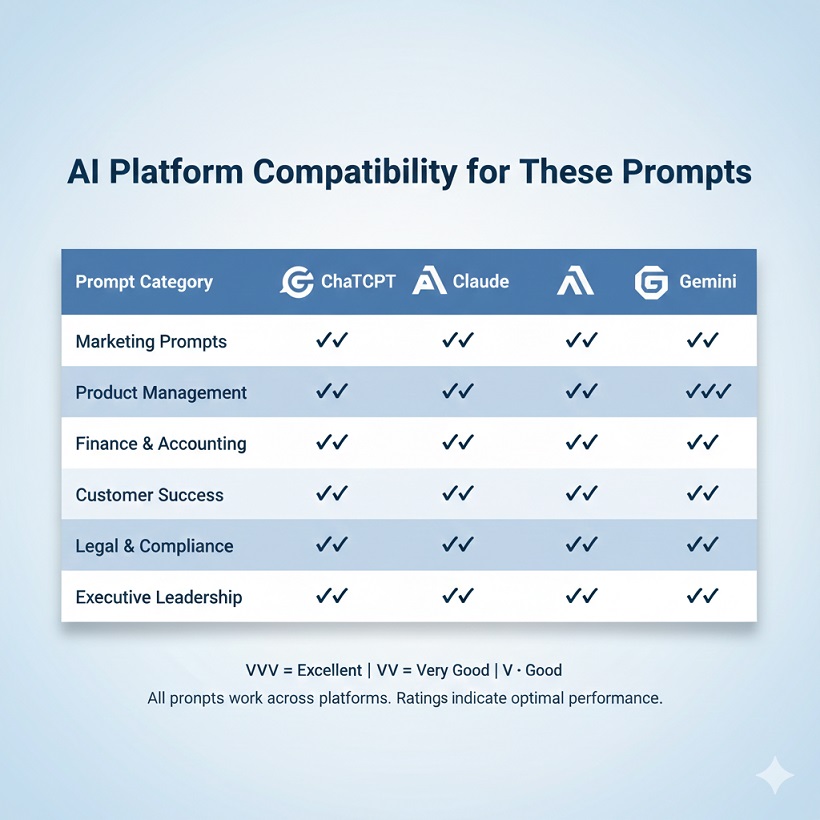
Answer: Part 2 focuses on more advanced and specialized business functions compared to Part 1. While Part 1 covered foundational prompts for marketing, sales, project management, and HR, Part 2 dives deeper into specialized areas like data analysis, financial modeling, product roadmaps, customer health scoring, crisis communication, and executive decision-making frameworks. Part 2 prompts are generally more complex, longer, and designed for intermediate to advanced users who are already familiar with basic AI interactions. Together, both parts provide a comprehensive 115-prompt library covering all major professional functions.
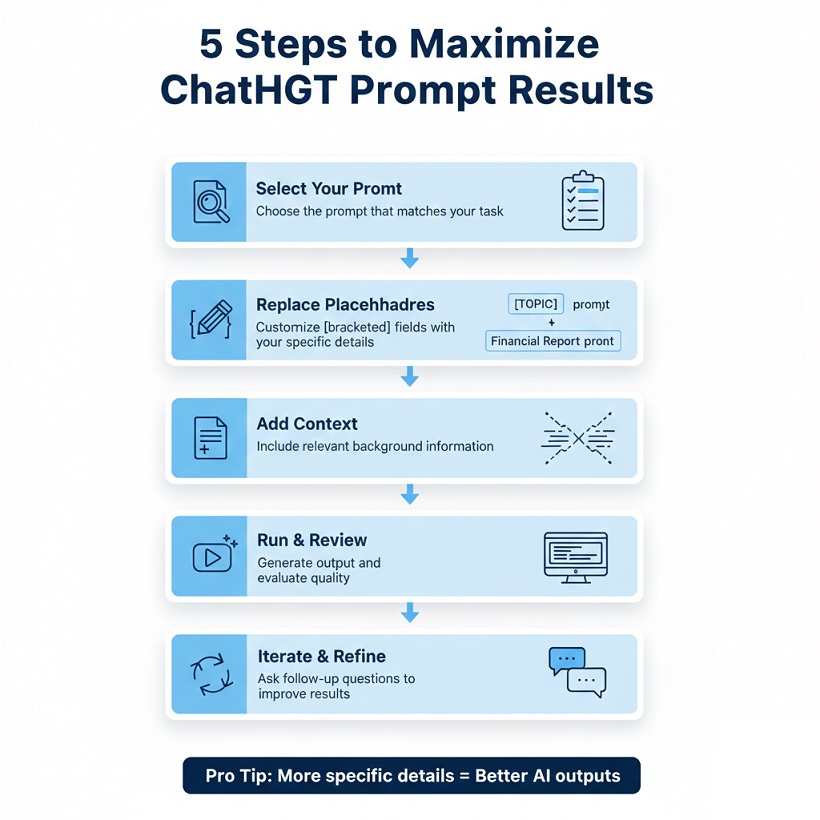
Answer: Customizing these prompts is simple and takes just minutes. Each prompt includes bracketed placeholders like
, [target audience], [budget], or [timeframe] that you should replace with your specific information. For best results:(1) Read the entire prompt first to understand its structure.
(2) Replace all bracketed items with detailed, specific information from your business.
(3) Add any additional context that’s relevant to your situation.
(4) Review the “Pro Tip” section for optimization suggestions.
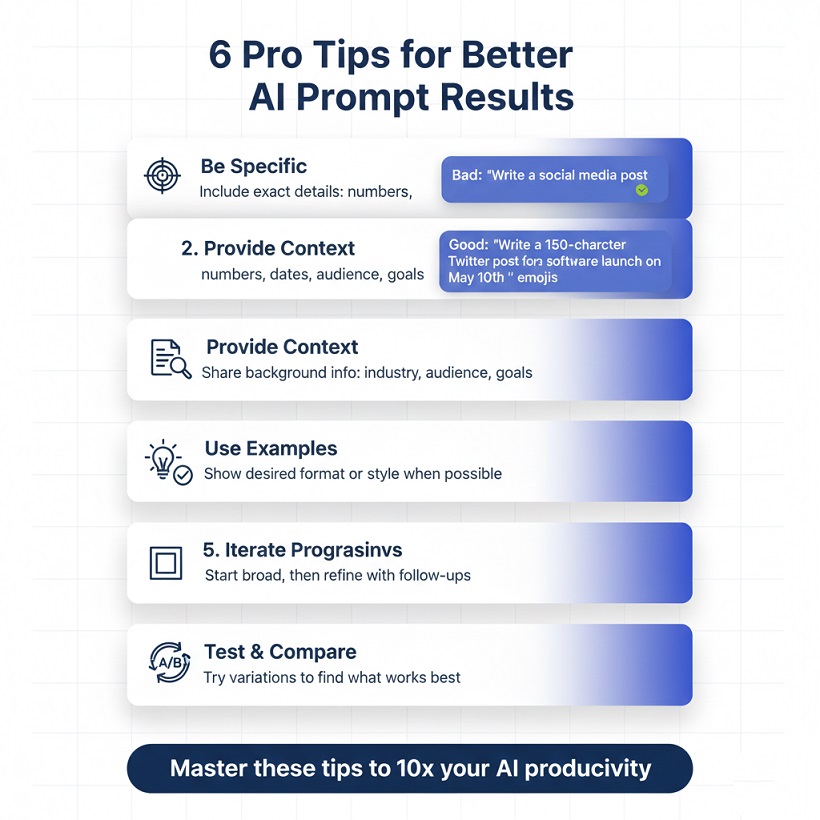
(5) Run the prompt and iterate on the output by asking follow-up questions or requesting adjustments. The more specific details you provide, the better and more relevant your AI-generated results will be.
Answer: Using structured AI prompts for business tasks offers multiple benefits:
(1) Time savings—complete tasks that normally take hours in minutes.
(2) Quality improvement—leverage best practices built into each prompt template.
(3) Consistency—standardize outputs across your team.
(4) Skill amplification—access expert-level frameworks even without deep expertise.
(5) Cost reduction—reduce dependency on expensive consultants for routine tasks.
(6) Faster decision-making—generate analysis and recommendations quickly.
(7) Learning opportunity—understand proper structures for business documents.
(8) Scalability—handle more projects without proportionally increasing headcount. Studies show professionals using AI prompts save 5-10 hours per week on average.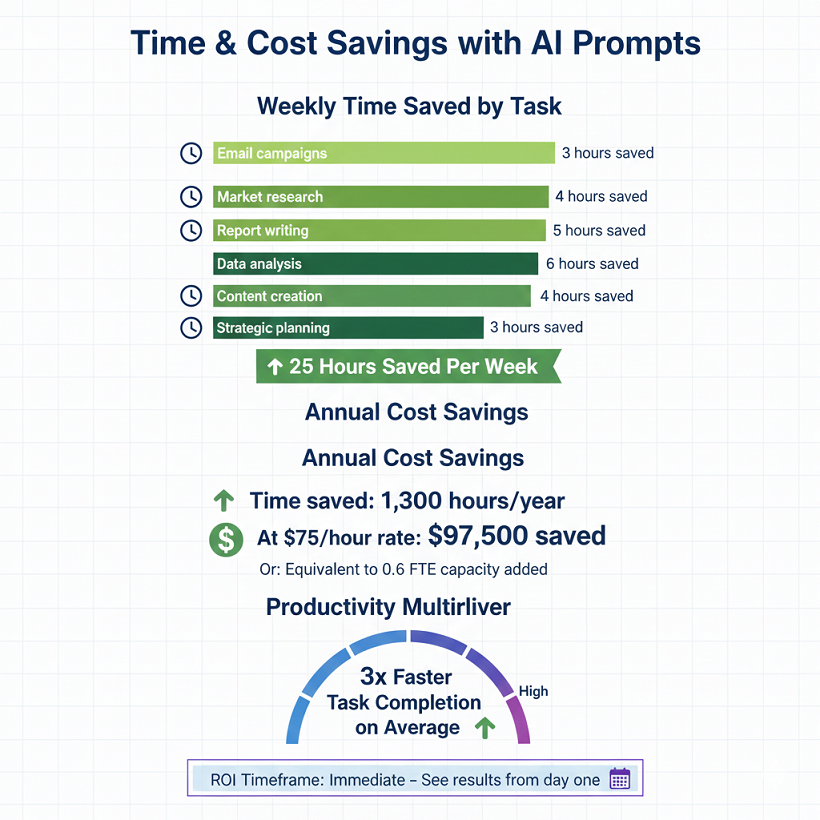
Answer: If you’re new to AI prompts, start with simpler, high-impact prompts that address immediate business needs. We recommend beginning with:
(1) Email marketing prompts (Prompt 46-47) for quick communication wins.
(2) Meeting notes templates (from Part 1) for immediate daily use.
(3) Customer feedback surveys (Prompt 65) for gathering actionable insights.
(4) Content calendar planning prompts for organized marketing.
(5) Basic data analysis prompts (Prompt 81) for making sense of your business metrics. Master 3-5 prompts thoroughly before expanding to more complex strategic prompts like financial modeling or product roadmaps. Practice with low-stakes tasks first to build confidence.
Answer: Absolutely! These prompts are designed to be valuable for businesses of all sizes, including small businesses, startups, solopreneurs, and large enterprises. Small businesses and startups particularly benefit because:
(1) They often lack specialized staff for every function—these prompts provide instant expertise.
(2) Limited budgets make AI-powered efficiency crucial.
(3) Founders wear multiple hats and need quick solutions across marketing, finance, and operations.
(4) Startups need to move fast and these prompts accelerate execution.
(5) Small teams can punch above their weight using professional-grade templates. Many prompts include guidance for scaling recommendations based on company size. Simply adjust the scope and resources mentioned in the prompts to match your business stage.
Answer: This prompt library is updated quarterly to reflect the latest AI capabilities, business best practices, and emerging professional needs. Updates include:
(1) New prompts for trending business challenges.
(2) Optimization of existing prompts based on user feedback and AI model improvements.
(3) Industry-specific variations and use cases.
(4) Integration of new AI features and capabilities.
(5) Removal of outdated or less effective prompts.
(6) Enhanced customization options. Each article includes a “Last Updated” date at the top. We recommend bookmarking this page and checking back every 3-4 months for the latest versions. Subscribe to our newsletter to receive notifications when major updates are published, including Part 3 with additional specialized prompts.
Answer: You can freely share these prompts with your team members, colleagues, and within your organization. These prompts are published as educational content to help professionals improve their AI productivity. We encourage internal team sharing to standardize workflows and amplify productivity across your organization. However, please: (1) Credit the source when sharing externally or in presentations.
(2) Don’t republish the complete collection on other websites or platforms.
(3) Don’t sell or commercialize these prompts as your own product.
(4) Link back to the original article when referencing these prompts in public content. For training purposes, workshop facilitation, or bulk organizational licensing, please contact us for appropriate permissions and customized solutions.
Conclusion
You now have access to 115 comprehensive ChatGPT prompts spanning every major business function. These prompts are designed to:
- Save time by providing ready-to-use templates
- Improve quality through structured, comprehensive approaches
- Maintain consistency across your organization
- Enable innovation by freeing time for strategic thinking
How to Get Maximum Value from These Prompts
- Customize for your context: Replace bracketed placeholders with your specific information
- Iterate and refine: Treat the AI’s first response as a draft and ask for improvements
- Build a prompt library: Save your customized versions for repeated use
- Combine prompts: Use multiple prompts together for complex projects
- Train your team: Share these prompts with colleagues to elevate everyone’s AI capabilities
Next Steps
- Bookmark this guide for easy reference
- Test 3-5 prompts most relevant to your role this week
- Share with your team to amplify collective productivity
- Track time saved to quantify the impact
- Provide feedback on which prompts deliver the most value
Stay Updated
AI and prompt engineering are rapidly evolving fields. Subscribe to our newsletter for:
- New prompts and templates
- Advanced AI techniques
- Industry-specific use cases
- Tool reviews and comparisons
Remember: The best prompt is one that’s actually used. Start with the prompts most relevant to your immediate needs, master those, then expand your AI capabilities over time.
Have questions or want to share how these prompts transformed your workflow? Leave a comment below or connect with us on [social media channels].
Related Articles:
- Part 1: ChatGPT Prompts 1-45 for Business Professionals
- AI Prompting for Beginners: Complete Guide [2025]
- ChatGPT vs. Claude vs. Gemini: Which AI is Best for Your Business?
Note:
Besides ChatGPT, you can also use other AI Tools like “Claude by Anthropic” and “Gemini by Google” to create AI prompts for your business solutions.

Recent Comments