AI Agents for Business Automation | Complete Guide 2026

If you’ve been using AI tools like ChatGPT or Claude to help with work tasks, you’ve experienced their power. But here’s what most business leaders are missing: those tools require you to direct every single action. You ask, they respond. You refine, they adjust. It’s helpful, but it’s still you doing the work.
Now imagine an AI that works independently. An AI that monitors your customer emails, understands the context, checks your inventory system, makes decisions about how to respond, sends the reply, updates your CRM, and only bothers you when something truly needs human judgment.
That’s an AI agent. And in 2026, they’re transforming how businesses operate.
Welcome to the era of autonomous workflow automation. In this guide, you’ll learn what AI agents actually are, how they differ from the AI tools you’re already using, and most importantly, how to implement them in your business to save time, reduce costs, and scale operations in ways that weren’t possible even a year ago.
What Are AI Agents? Understanding the Fundamentals
Let’s start with a clear definition: AI agents are autonomous systems that perceive their environment, make decisions based on goals you’ve set, and take actions without constant human direction.
Think of it this way. When you use ChatGPT, you’re the driver. You steer every conversation, make every decision about what to do next, and execute any actions yourself. With an AI agent, you’re more like a manager. You define the goal, set the boundaries, and let the agent figure out how to achieve it.
The difference becomes obvious with a simple example. Say a customer’s email asking about their order status.
Traditional automation would route that email to your support queue based on keywords. That’s it. A human still needs to read it, check the order system, and respond.
An AI copilot (like ChatGPT) would help your support person draft a response more quickly. Still requires the human to check the order, make decisions, and hit send.
AI agent reads the email, understands the customer is asking about order #47291, checks your order management system, sees the package is delayed, determines this customer is a VIP based on purchase history, decides to offer expedited shipping for free, updates the shipping, sends a personalized apology email, logs everything in your CRM, and only escalates to a human if there’s a complication it can’t handle.
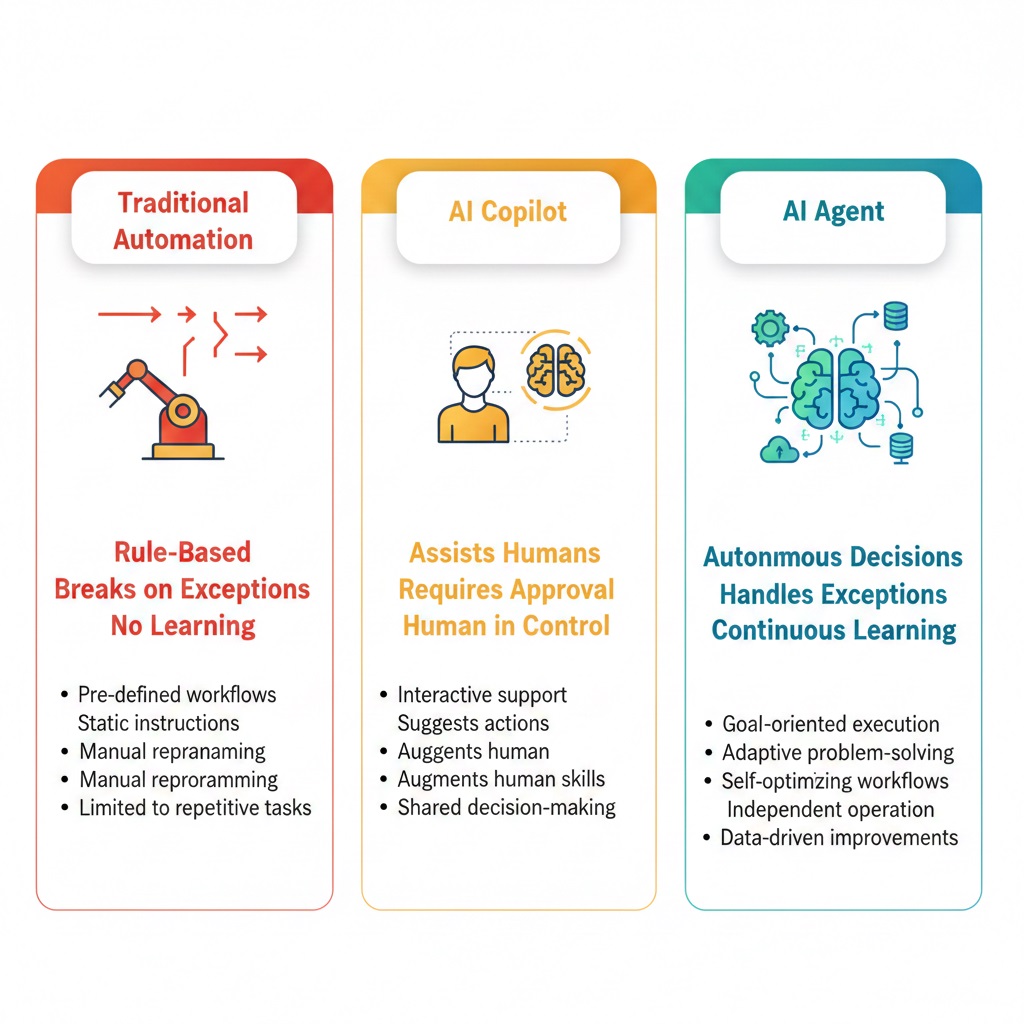
See the difference? The agent isn’t just assisting, it’s completing the entire workflow autonomously.
AI agents have four core capabilities that enable this autonomy: perception (gathering information from multiple sources), reasoning (making contextual decisions), action (executing tasks through integrations), and learning (improving from outcomes over time). This combination transforms them from helpful tools into genuine digital workers.
AI Agents vs. Traditional Automation: Why This Changes Everything
You might be thinking, “We’ve had automation for years. How is this different from the workflow automation we’re already using?”
Fair question. Traditional automation, often called Robotic Process Automation (RPA), is powerful but fundamentally limited. It follows fixed rules. If this happens, do that. If the email contains “refund,” route it to the refund department. And if inventory drops below 100 units, send a reorder notification.
This works beautifully until something unexpected happens. The customer uses different words. The supplier changes their system. A new product doesn’t fit your existing categories. Traditional automation breaks, and suddenly you’re spending hours fixing workflows or manually handling exceptions.
AI agents handle exceptions. They understand context and nuance because they use large language models as their reasoning engine. When a customer writes “I’m not happy with what I received,” the agent understands that’s a complaint even without the word “complaint.” When market conditions change, the agent adjusts its decision-making rather than blindly following outdated rules.
Here’s a practical comparison. Imagine you’re managing inventory for an e-commerce business.
Traditional automation reorders products when stock hits a predetermined threshold. Simple, reliable, but dumb. It doesn’t know that summer is coming and demand for swimwear is about to spike. It doesn’t factor in that your supplier just announced a price increase next month. And it can’t adjust order quantities based on cash flow concerns.
AI agent monitors inventory levels, analyzes historical sales patterns, considers seasonal trends, tracks supplier pricing and lead times, evaluates current cash position, predicts demand based on marketing campaigns you’re running, and makes intelligent ordering decisions that balance all these factors. When an unexpected TikTok video makes one of your products go viral, the agent notices the spike and adjusts orders immediately rather than waiting for you to manually intervene.
The implications are massive. Organizations using AI agents report transforming processes that traditional automation couldn’t touch, customer service interactions that require understanding context, sales workflows that need judgment calls, and content creation that demands creativity within brand guidelines.
But here’s the critical insight that separates successful implementations from failed experiments: AI agents don’t work by simply layering them onto existing processes. They require rethinking how work gets done. Companies that succeed redesign workflows around what agents do well, rather than trying to make agents fit into human-designed processes.
Why Businesses Need AI Agents Now: The 2026 Reality
The business case for AI agents has undergone a significant shift in the past year. This isn’t experimental technology anymore; it’s operational infrastructure delivering measurable returns.
Recent research reveals that two-thirds of organizations are actively experimenting with AI agents. But here’s the telling statistic: fewer than one in four are successfully scaling them beyond initial pilots. The difference between those who succeed and those who struggle comes down to approach.
The winners aren’t treating AI agents as a technology project. They’re treating them as a business transformation that happens to use AI. They’re redesigning workflows, establishing governance frameworks, and building new operational models around human-AI collaboration.
The ROI is becoming impossible to ignore. Telus reports saving 40 minutes per AI interaction across 57,000 employees. That’s not a marginal improvement; it’s transformational. Suzano reduced query time by 95% for 50,000 employees. Danfoss automated 80% of transactional decisions and cut response time from 42 hours to near-real-time.
These aren’t tech companies with unlimited resources. They’re traditional businesses finding that AI agents deliver returns that traditional automation couldn’t approach.
Three major trends are converging to make 2026 the inflection point for AI agents in business.
First, multi-agent collaboration is moving from research labs to production. Instead of single agents working in isolation, businesses are deploying coordinated teams of specialized agents. Your sales agent talks to your finance agent for pricing approvals. Your customer service agent coordinates with your logistics agent for delivery updates. And your marketing agent works with your data agent for campaign optimization. This creates a compound value that single-agent implementations can’t match.
Second, the technology has crossed the usability threshold. A year ago, implementing AI agents required significant technical expertise. Today, platforms like Salesforce Agentforce, Microsoft Copilot Studio, and dozens of specialized tools offer agent capabilities that business users can configure without writing code. The barrier to entry has collapsed.
Third, and perhaps most importantly, measurable ROI has become the expectation rather than the exception. Early adopters had to make the case based on potential. Now there’s real data. Businesses know what returns to expect, which use cases deliver the fastest value, and how to structure implementations for success.
The competitive dynamics are shifting. While AI agents were a nice-to-have advantage for early adopters, they’re rapidly becoming table stakes. When your competitor can respond to customer inquiries in two minutes instead of two hours, when they can qualify three times as many leads with the same sales team, when they can optimize operations with real-time data instead of quarterly reviews, you can’t compete on the old operating model.
The window for “fast follower” advantage is closing. The businesses that start implementing AI agents now will build expertise, refine their approaches, and scale their capabilities over the next 12-24 months. Those who wait will find themselves not just behind on technology, but fundamentally less efficient than competitors who’ve built their operations around human-AI collaboration.
Types of AI Agents and Their Business Applications
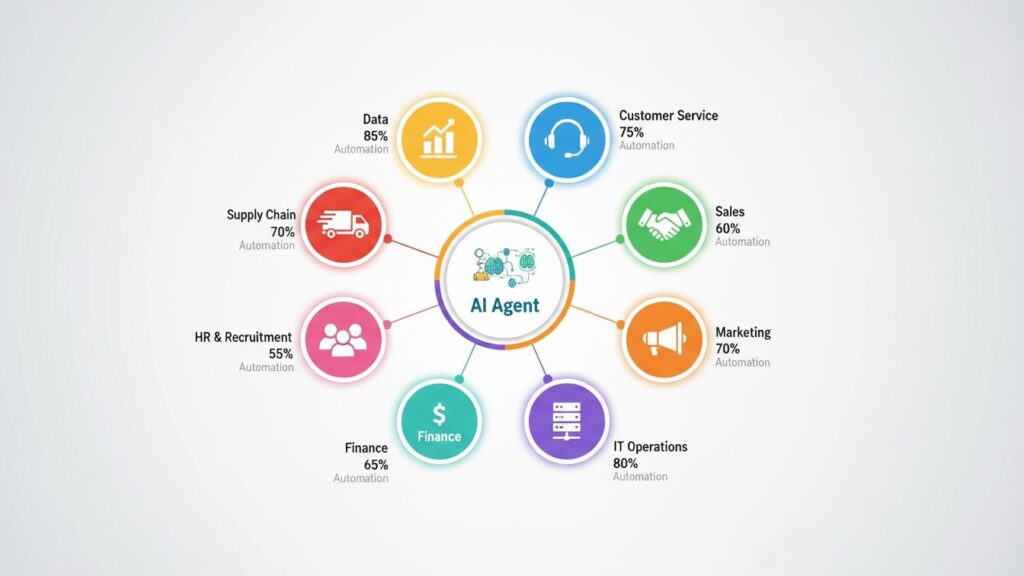
AI agents aren’t one-size-fits-all. Different business functions need different types of agents with specialized capabilities. Understanding these categories helps you identify where agents can deliver the most value in your organization.
Customer-Facing Agents:
Customer Service Agents handle the bulk of routine inquiries that consume support team resources. These agents manage questions across email, chat, social media, and phone channels. They access your knowledge base, check order histories, understand return policies, and resolve 60-80% of standard requests without human intervention.
The key is intelligent escalation. When a customer is angry, when the issue falls outside defined parameters, or when the agent isn’t confident in its solution, it immediately routes the conversation to a human team member with complete context. The customer doesn’t repeat their story, and your support person has all the information needed to resolve the issue quickly.
Sales Agents transform how businesses handle lead qualification and outreach. These agents research prospects, analyze whether they fit your ideal customer profile, craft personalized outreach messages, follow up at optimal times, and book meetings with qualified leads. Your sales team focuses on conversations with people who are actually ready to buy, rather than spending half their time chasing dead ends.
One B2B software company implemented a sales agent that researches prospects on LinkedIn, checks their company’s recent news and funding, identifies relevant pain points, and sends personalized emails that reference specific business challenges. Their sales team went from booking 10 qualified meetings per week to 30, without increasing headcount.
Internal Operations Agents:
Data Analysis Agents translate natural language questions into database queries, generate reports, identify trends, and flag anomalies. Instead of waiting days for your data team to pull reports, managers ask questions and get answers in minutes. These agents work particularly well for financial analysis, sales reporting, and operational metrics.
Suzano, a major forestry company, deployed data agents that reduced query time by 95% for 50,000 employees. Workers who previously waited days for data insights now get immediate answers, enabling faster decision-making throughout the organization.
Workflow Orchestration Agents coordinate complex processes that involve multiple systems and stakeholders. They manage project timelines, track dependencies, allocate resources based on priorities, send reminders, and adjust plans when delays occur. Think of them as project managers that never sleep, never forget, and scale infinitely.
IT Operations Agents monitor system health, predict potential failures, investigate alerts, and, in many cases, resolve issues before users even notice problems. They analyze log files, correlate events across systems, apply patches, and maintain detailed documentation of every action taken. For DevOps teams drowning in alerts, these agents are transformative.
Specialized Industry Agents:
Supply Chain Agents track inventory across locations, predict demand fluctuations based on historical patterns and market signals, optimize ordering to balance cost and availability, and coordinate with logistics systems. Danfoss implemented supply chain agents that automated 80% of transactional decisions and reduced response time from 42 hours to near-real-time.
Content and Marketing Agents generate content variations for different audiences, schedule posts at optimal times, monitor performance metrics, and adjust strategies based on results. They’re not replacing human creativity; they’re scaling it. Your team creates the strategy and core message; agents adapt it for 50 different audience segments.
HR and Recruitment Agents screen applications against job requirements, schedule interviews, send reminders and follow-ups, answer candidate questions about policies and benefits, and guide new hires through onboarding processes. For companies hiring at scale, these agents reduce time-to-hire while improving candidate experience.
The pattern across all these types is the same: agents excel at high-volume, rule-based-with-exceptions work that requires accessing multiple systems and making contextual decisions. They free humans to focus on tasks requiring genuine creativity, complex judgment, relationship building, and strategic thinking.
How AI Agents Work: The Technical Foundation (Simplified)
You don’t need to be a data scientist to implement AI agents, but understanding the basics helps you use them effectively and troubleshoot when issues arise.
At the core, AI agents combine several technologies working together. The perception layer connects to your data sources, your CRM, email, databases, and various APIs. It monitors for triggers like a new email arriving or inventory dropping below a threshold. When something happens, the agent gathers relevant context from multiple systems.
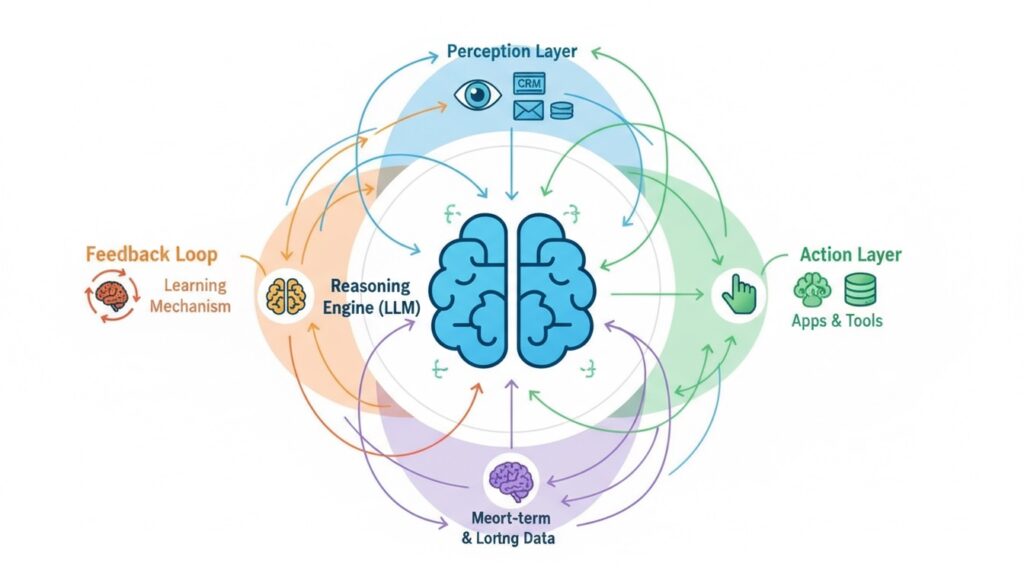
The reasoning engine, powered by a large language model, acts as the agent’s brain. It understands context and nuance in ways traditional software can’t. When a customer writes “I’m frustrated with how long this is taking,” the agent understands that’s a complaint about delivery time, even though those exact words weren’t used. It can consider multiple factors simultaneously and make judgment calls within the boundaries you’ve set.
Memory systems give agents the ability to maintain context. Short-term memory holds the current conversation or task that we’re discussing right now. Long-term memory stores historical data, past interactions, and learned patterns. This combination allows agents to reference previous conversations, learn from outcomes, and improve their decision-making over time.
The action layer executes the agent’s decisions through integrations with your business systems. When the agent decides to update a CRM record, send an email, place an order, or trigger another workflow, this layer handles the actual execution. Good agent platforms come with pre-built integrations for popular business tools, dramatically reducing implementation complexity.
A feedback loop ties everything together. The agent monitors outcomes, learns from successes and failures, and refines its approach. When a particular email template generates better responses, the agent incorporates that learning into future communications. When an escalation turns out to be unnecessary, the agent adjusts its escalation criteria.
Two emerging standards are making AI agents even more powerful. The Model Context Protocol (MCP) standardizes how agents access data and tools, making it easier to give agents secure access to your systems. Agent-to-Agent (A2A) protocols enable agents from different vendors to communicate and collaborate, so your Salesforce agent can work seamlessly with your supply chain agent even if they’re built on different platforms.
Here’s a complete workflow example. A customer emails about a late delivery. The agent’s perception layer captures the email and retrieves the order status, customer history, and current shipping information. The reasoning engine analyzes that this is a VIP customer who’s genuinely concerned (not just inquiring), that the delay is three days, and that similar situations have been resolved well with expedited shipping plus a courtesy discount. The agent decides on a specific action plan: upgrade to overnight shipping, apply a 15% discount to the next order, and send a personalized apology. The action layer executes all these steps across multiple systems. The feedback loop tracks whether the customer accepts the resolution and uses that outcome to refine future decisions.
The beautiful part is that modern platforms abstract away most of this complexity. You focus on defining what you want the agent to accomplish, and the platform handles the technical orchestration.
Implementing AI Agents: A Practical Roadmap
The difference between successful AI agent implementations and failed pilots usually comes down to approach. Here’s a proven roadmap for getting it right.
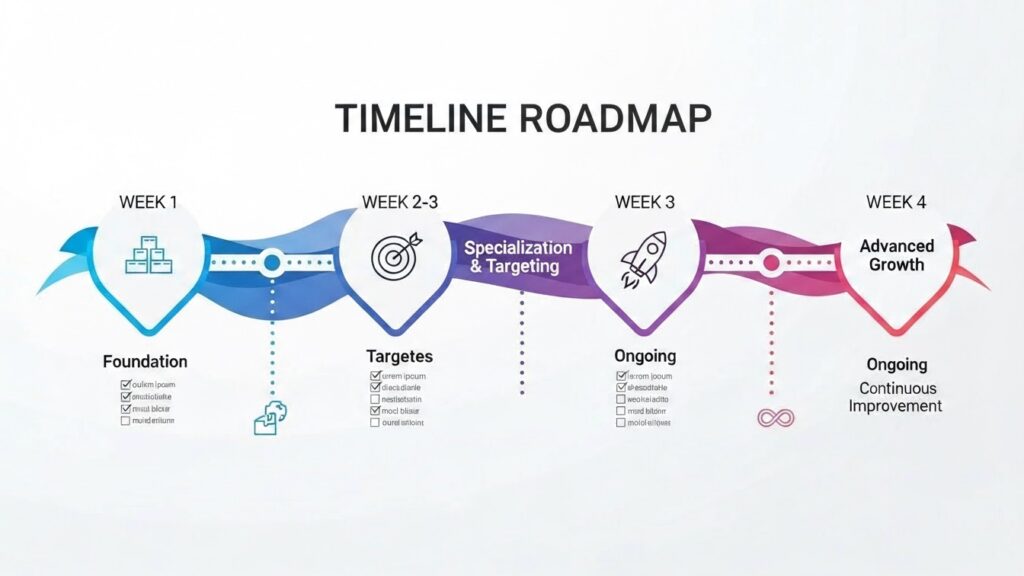
Start by identifying high-value processes. Look for tasks that are repetitive and time-consuming, have clear rules but require handling exceptions, involve decision points based on available data, and currently create bottlenecks in your operations. Customer inquiry routing, lead qualification, report generation, appointment scheduling, and data entry from documents are all excellent starting points.
Avoid processes that change frequently, require deep human judgment on nuanced ethical questions, have severe consequences if mistakes occur, or aren’t documented well enough to explain to an agent. You’ll eventually expand to more complex use cases, but starting focused dramatically improves your odds of success.
Map your current workflow in detail. Document every step, identify decision points and what information drives those decisions, note exceptions and edge cases, and measure current time and cost. This baseline is crucial for demonstrating ROI later and helps you clearly define what success looks like.
Define success metrics before you start building. Following guidance from leading consultancies, set concrete outcomes with suitable hard metrics. Time saved per week, cost reduction per month, quality improvement measured by error rates, customer satisfaction changes, and direct business impact, like revenue increase or churn reduction. Vague goals like “improve efficiency” lead to ambiguous results and make it impossible to know if your agent is actually working.
Choose the right platform based on your specific situation. If you’re already using Salesforce or Microsoft 365, their agent platforms offer the easiest path. For customer service focus, specialized tools like Kommunicate provide purpose-built solutions. If you need custom workflows, Make.com or Zapier offer flexibility. Technical teams wanting maximum control should explore open-source options like LangChain or n8n.
Start with one agent doing one thing well. This is where most organizations go wrong—trying to automate everything at once. Focus on a single well-defined task, set clear boundaries and escalation rules, build in human oversight initially, and run in parallel with your existing process to compare results. A successful pilot that saves 10 hours per week builds the credibility and expertise needed to scale.
Test rigorously before full deployment. Run 20-30 test scenarios, including edge cases and potential errors. Compare agent outputs side-by-side with human-generated results. Gather feedback from team members who’ll work with the agent. Document issues and iterate until the agent handles the core workflow reliably.
Measure religiously and iterate continuously. Track your defined success metrics daily at first, then weekly as the agent stabilizes. Gather qualitative feedback about what’s working and what’s frustrating. Adjust agent behaviors based on results. This continuous improvement approach turns good agents into great ones.
Expand scope gradually as confidence grows. Add related tasks to successful agents rather than deploying entirely new agents. Increase autonomy by reducing human oversight checkpoints. When you’re ready for a second agent, apply everything you learned from the first. This measured expansion balances ambition with risk management.
Build governance from day one, even for pilots. Define approval processes for what agents can and cannot do. Set data access controls. Establish audit trails for every agent action. Create escalation protocols for issues. Implement security measures appropriate to the data agents’ access. Organizations that skip governance in the pilot phase struggle to scale because they have to retrofit policies later.
The most common implementation mistake is starting too broadly. Attempting to automate entire departments or customer journeys leads to complexity that overwhelms teams and budgets. The organizations succeeding with AI agents start with focused pilots that prove value quickly, build internal expertise through doing, establish governance frameworks, and scale systematically based on measured results.
Top AI Agent Platforms and Tools for 2026
The AI agent platform landscape has matured significantly in the past year. Here’s what you need to know about the leading options.
Salesforce Agentforce dominates the enterprise market for organizations already invested in the Salesforce ecosystem. It offers pre-built agents for common CRM workflows, deep integration with Sales Cloud and Service Cloud, and industry-specific templates. At $2 per conversation, it’s premium-priced but delivers comprehensive capabilities for large organizations. The platform makes most sense if Salesforce is already central to your operations.
Microsoft Copilot Studio provides the smoothest path for organizations using Microsoft 365. With templates for customer service, retail operations, and knowledge work, plus integration with Azure and Power Platform, it enables rapid deployment for Microsoft-centric environments. The low-code builder makes agent development accessible to business users, not just developers. Pricing is included with certain Microsoft 365 plans, making it cost-effective for existing customers.
Google Cloud AI Agents excel at data-heavy operations and technical workflows. The platform provides advanced analytics capabilities, multi-agent orchestration, and cross-platform agent communication via emerging standards. The learning curve is steeper, but technical teams appreciate the power and flexibility. Usage-based pricing can be complex to predict, but it scales well for organizations with variable demand.
For mid-market and small businesses, Kommunicate has emerged as the customer service automation leader. With multi-channel support across web, mobile, WhatsApp, and Instagram, clear AI-to-human handoff, and no-code configuration, it’s accessible and affordable. Starting at $34 per month for the starter plan and $167 for professional, it delivers strong value for businesses focused on customer support automation.
Clay has captured significant mindshare in sales and marketing automation. Integrating with 100+ data sources for lead enrichment and qualification, it automates outreach workflows that previously required hours of manual research. B2B teams particularly appreciate how it transforms prospecting from tedious research into automated pipeline generation. Starting at $149 monthly, it’s positioned for growth-focused teams.
For custom workflow automation, Make.com offers remarkable flexibility through its visual workflow builder. With AI tool integrations for ChatGPT, Claude, and Perplexity, plus 1000+ app connections, it enables sophisticated automation without traditional coding. The free tier lets you experiment, with paid plans from $9 monthly. The visual interface makes complex workflows understandable and maintainable.
Technical teams wanting maximum control should evaluate n8n, an open-source workflow automation platform offering self-hosted deployment options for data privacy and full extensibility. The free self-hosted option appeals to organizations with security requirements or existing infrastructure, while cloud hosting starts at $20 monthly for those preferring managed services.
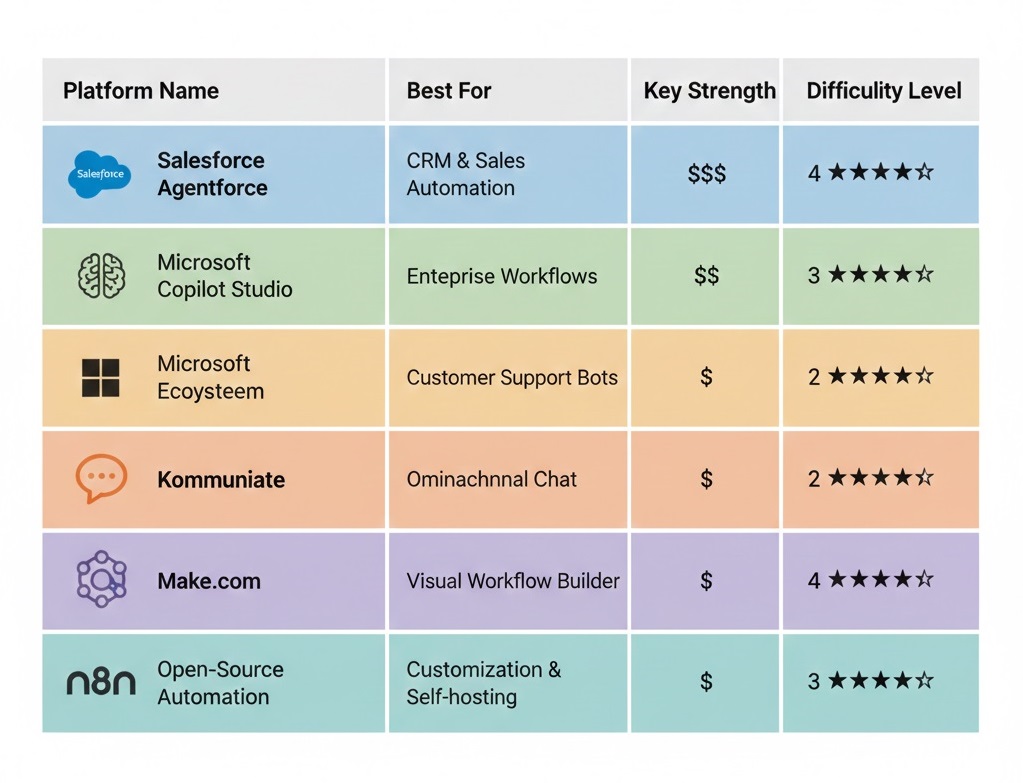
The selection criteria come down to three questions: What’s your existing tech stack (choose platforms that integrate natively), what’s your technical capability (no-code for business users, open-source for developers), and what’s your budget (enterprise platforms for large organizations, specialized tools for specific functions, flexible workflow builders for custom needs)?
Most successful organizations don’t choose just one platform. They use enterprise platforms for core business agents, specialized tools for function-specific needs, and workflow automation for custom integrations. This hybrid approach maximizes capabilities while controlling costs.
Real Business Use Cases and ROI Examples
Theory is interesting, but nothing beats concrete examples of AI agents delivering measurable business value. Here are real-world implementations with actual results.
E-commerce customer service transformation: A mid-size online fashion retailer faced 2,000+ daily customer inquiries with 24-hour response times, frustrating customers and driving up support costs. They implemented a customer service agent handling order tracking, returns, and sizing questions with human escalation for complex issues.
The results were dramatic. Seventy-five percent of inquiries were resolved without human intervention, response time dropped from 24 hours to 2 minutes, customer satisfaction increased from 3.8 to 4.6 out of 5, and they avoided hiring three additional support staff—$180,000 in annual savings. First-year ROI exceeded 450%. The key was starting with the most common inquiry types and maintaining clear escalation paths for issues requiring human judgment.
B2B lead qualification revolution: A SaaS company selling project management software to mid-market businesses found their sales team spending 40% of their time on leads that would never convert. They deployed a sales agent who researches prospects using LinkedIn and company data, scores leads based on ideal customer profile fit, and books meetings with qualified prospects.
The transformation shocked even optimistic stakeholders. Sales reps now focus on three times more qualified prospects, conversion rates increased from 2% to 6%, the sales cycle shortened by 15 days, and revenue per sales rep jumped 35%. The company attributed $750,000 in additional first-year revenue directly to better lead qualification. The breakthrough came from clearly defining their ideal customer profile and integrating the agent with their CRM and data enrichment tools.
Financial services efficiency gain: A regional bank’s finance team spent 60 hours monthly generating regulatory compliance reports, tedious work prone to errors that consumed resources better spent on strategic analysis. They implemented a data analysis agent that pulls information from multiple systems, validates data consistency, and generates reports following regulatory templates.
Report generation time collapsed from 60 hours to 2 hours. Error rates dropped from 8% to 0.5%. The finance team redirected its time toward analyzing trends and supporting business decisions. Beyond the $125,000 annual savings, faster reporting enabled better decision-making throughout the organization. Critical to success was mapping report requirements precisely and building multi-layer validation before they trusted the agent with regulatory submissions.
Manufacturing supply chain optimization: An electronics manufacturer struggled with frequent stockouts, hurting customer relationships, and excess inventory tying up capital. They deployed a supply chain agent monitoring inventory levels, predicting demand based on historical patterns and market signals, and automatically placing orders within defined parameters.
Stockout incidents fell 80%, inventory carrying costs decreased 25%, order fulfillment improved 18%, and supplier relationships strengthened due to more predictable ordering patterns. The first-year savings exceeded $2.1 million. They succeeded by starting with a single product line, integrating comprehensive historical data, setting conservative initial parameters, and gradually increasing agent autonomy as confidence grew.
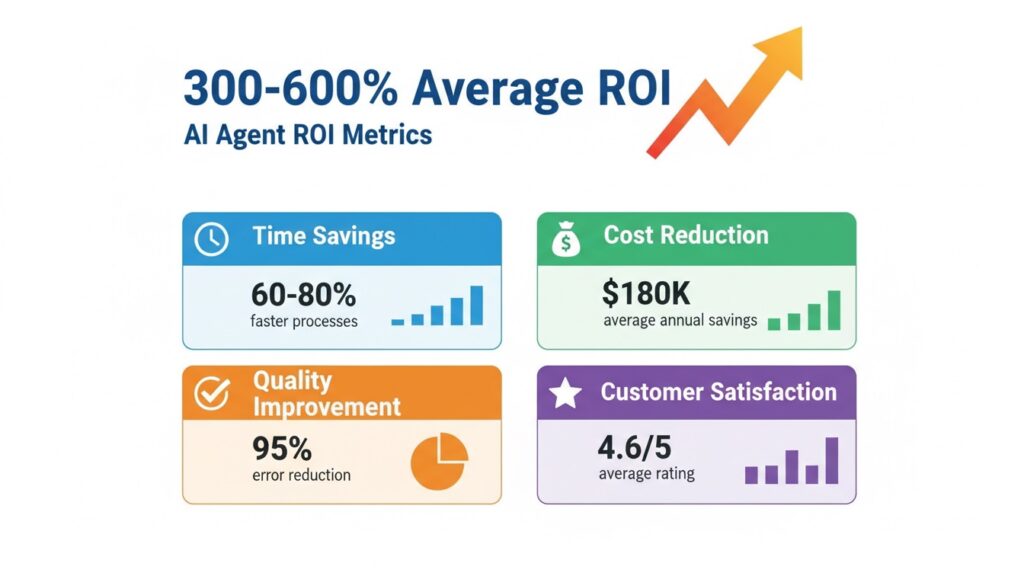
These examples share common patterns. Start focused on specific, measurable problems. Integrate thoroughly with existing systems. Define clear success metrics upfront. Maintain appropriate human oversight initially. Scale based on proven results rather than ambitious plans.
For organizations considering AI agents, ROI calculations should include both hard savings (time, labor costs, error reduction) and softer benefits (faster decisions, better customer satisfaction, improved employee experience). Typical first-year ROI ranges from 200% for sales qualification to 800% for data and report generation, with most implementations delivering 300-500% returns.
Challenges and Limitations in AI Agents in Business Automation: What to Expect
AI agents deliver impressive results, but they’re not magic. Understanding realistic limitations helps set appropriate expectations and avoid common pitfalls.
The hallucination problem remains real. AI agents sometimes generate plausible-sounding but incorrect information, particularly when asked about topics where they lack reliable data. This affects report accuracy, customer communications, and decision-making. Mitigation requires building validation checks into workflows, using retrieval systems that pull from actual data rather than generating answers, maintaining human review for high-stakes decisions, and implementing clear error reporting so agents acknowledge uncertainty.
Integration complexity challenges many implementations. Connecting agents to legacy systems, dealing with inconsistent data formats across platforms, managing authentication and security, and maintaining connections as systems update all create technical debt. Success depends on starting with well-documented APIs, using platforms with pre-built connectors, investing in integration expertise, whether internal or external, and considering middleware tools like Make or Zapier to simplify complex integrations.
Change management often determines whether agents succeed or fail despite perfect technology. Team resistance to AI taking over familiar tasks, fear of job displacement, and skepticism about AI reliability create adoption barriers. Overcoming this requires involving teams in design processes, demonstrating how agents eliminate tedious work rather than jobs, building collaboration models where humans and AI work together, and providing training and ongoing support.
Data quality and access issues undermine agent performance. AI agents need clean, well-organized data to make good decisions. Poor data quality leads to poor agent decisions, creating a vicious cycle. Organizations must audit data quality before implementation, implement data governance practices, start with high-quality data sources, and improve data practices alongside agent deployment.
Cost at scale surprises many organizations. Usage-based pricing from major platforms can escalate quickly as agent interactions multiply. What seemed affordable during pilots becomes budget-straining at full deployment. Smart approaches include negotiating enterprise pricing that caps costs, monitoring usage closely to identify inefficiencies, optimizing agent efficiency to reduce redundant operations, and considering self-hosted options for high-volume use cases.
Security and compliance require continuous attention. Agents accessing sensitive data and making consequential decisions create risk. Data breaches, compliance violations, and reputational damage from agent mistakes are real possibilities. Protection requires implementing bounded autonomy with clear operational limits, maintaining comprehensive audit trails, potentially deploying governance agents to monitor other agents, and conducting regular security reviews.
What AI agents cannot do yet and organizations should not expect them to handle—includes deep creative thinking and innovation requiring breakthrough insights, complex ethical judgments weighing multiple values, true emotional intelligence and empathy, understanding nuanced human dynamics in sensitive situations, and tasks requiring deep relationship building. Agents excel at scalable, rules-with-exceptions work. Humans remain essential for strategy, creativity, complex judgment, and relationship management.
The key to success is matching agents to appropriate tasks, setting realistic expectations, maintaining appropriate oversight, and building in continuous improvement processes. Organizations that acknowledge limitations while leveraging agent strengths achieve the best results.
The Future of AI Agents: What’s Coming Next
The AI agent landscape is evolving rapidly. Understanding emerging trends helps you prepare and position your organization for what’s ahead.
Agent-to-agent collaboration represents the next major leap. By 2026, businesses will start to connect specialized agents into coordinated teams that handle entire workflows. Your sales agent negotiates pricing with your finance agent. Your customer service agent coordinates with your logistics agent for real-time delivery updates. And your marketing agent consults your data agent for campaign optimization. Multi-agent systems create compound value that isolated agents cannot match.
Industry-specific specialized agents are replacing general-purpose tools. Healthcare agents provide diagnostic assistance and manage claims processing. Legal agents analyze contracts and monitor regulatory compliance. Manufacturing agents handle predictive maintenance and quality control. Financial services agents detect fraud and optimize portfolios. These domain-enriched agents understand industry context in ways general tools cannot, delivering higher accuracy and relevance.
Physical AI integration is beginning to emerge. Warehouse robots with AI decision-making adapt to changing conditions. Autonomous logistics systems optimize delivery routes in real-time. Smart manufacturing facilities adjust production based on demand signals. Embodied agents that handle physical tasks combine sensing, reasoning, and action in the physical world.
Smaller, more efficient models are transforming economics. The shift toward models that are multimodal and easier to tune for specific domains means lower costs to run agents, faster response times, the ability to run agents locally on-device for privacy, and better control over agent behavior. This democratizes access to agent technology beyond large enterprises.
Governance frameworks are becoming standard infrastructure. As AI agents take on consequential decisions, compliance and security shift from background concerns to central pillars. Automated policy enforcement, continuous security monitoring, AI-specific regulatory frameworks, and governance agents monitoring other agents are emerging as essential capabilities.
The licensing versus building decision is crystallizing. 2026 appears to be the year enterprises stop trying to build proprietary AI agents from scratch and start licensing pre-built solutions. Industry-specific agent marketplaces, standardized pricing models, and easier procurement make buying more attractive than building for most organizations.
Human-AI collaboration models are maturing. Rather than replacing humans or just assisting them, we’re seeing new organizational structures where AI agents are team members with specific roles. This creates demand for new positions: AI orchestrators who manage multiple agents, agent trainers who improve performance, governance specialists who ensure responsible use, and human-agent interface designers who optimize collaboration.
For business leaders, the timeline looks like this. In 2026, deploy first single-purpose agents, build governance frameworks, and experiment with multi-agent systems. Through 2027-2028, scale to multiple coordinated agents, adopt industry-specific solutions, and integrate with physical systems where relevant. By 2029-2030, AI agents become standard business infrastructure, entire departments operate with high autonomy, and human focus shifts to strategy and creativity.
Preparing your organization requires starting experimentation now because the learning curve is real, building AI literacy across all levels, investing in data infrastructure and governance, thinking about processes, not just tools, and partnering with vendors embracing open standards to avoid lock-in.
Getting Started: Your First AI Agent This Month
You’ve learned what AI agents are, seen real results, and understand the landscape. Now let’s get practical about implementation.
Your first step is identifying the right use case. Use this simple framework: high volume plus low complexity plus clear rules equals the perfect first agent. Avoid complex exceptions or high-stakes decisions for your initial implementation. Write down specifically what task you’re automating, how long it takes currently, and what it’s costing in time and money.
Choose a platform based on your situation. Already have Salesforce or Microsoft? Start with their agent tools integration, which will be easiest. Need customer service specifically? Try Kommunicate’s free trial. Want custom workflows? Make.com’s free tier lets you experiment. Have a technical team? Explore LangChain or n8n open-source options.
Map your process in detail before building anything. Document every step of how the task works today. Note decision points and what information drives each decision. Define success: what does “done right” look like? Set specific metrics for time, cost, quality, and satisfaction. This preparation determines whether your implementation succeeds or struggles.
For your build phase, set up your chosen platform and connect necessary data sources. Test integrations thoroughly; this is where many implementations fail. Configure your first agent with clear instructions using the prompt engineering skills from your previous learning. Set up escalation rules for when the agent should hand off to humans. Build in safety checks appropriate to the risk level.
Test extensively in a sandbox environment. Run 20-30 test scenarios, including normal cases, edge cases, and potential errors. Document what works and what doesn’t. Iterate based on results before exposing the agent to real work.
Launch your pilot by running in parallel with your existing process. Monitor closely during the first week. Fix issues immediately: rapid iteration during the pilot phase is critical. Gather feedback from team members who interact with the agent. Compare results to your baseline metrics.
After two weeks, measure rigorously. How much time are you actually saving? Is quality maintained or improved? What’s the cost impact? What does user satisfaction look like? These metrics justify scaling and guide improvements.
Transition to full deployment gradually. Set up monitoring dashboards to track ongoing performance. Establish a regular review cadence, weekly at first, then monthly as the agent stabilizes. Create documentation for how team members should work with the agent.
Train your team on working with the agent. When to trust it, when to escalate, how to provide feedback, and basic troubleshooting. Good training dramatically improves adoption and outcomes.
Use your first month of data to optimize and plan next steps. Analyze what worked and what needs improvement. Identify your next agent deployment based on lessons learned. Share success with stakeholders to build support for scaling.
Your “good enough to start” checklist includes one specific, well-defined task, a measurable baseline for current time and cost, agent access to the data it needs, a human escalation path for issues the agent can’t handle, defined success metrics, basic governance covering who’s responsible and what’s allowed, and team buy-in that people will actually use it.
Don’t wait for perfect data, complete documentation, executive approval for experiments, ideal processes, or advanced AI knowledge. These create analysis paralysis. Start focused, learn by doing, and iterate based on results.
Quick wins to build momentum include email triage and routing (high volume, clear rules), FAQ responses (limited scope, easy to validate), meeting scheduling (straightforward, time-saving), data entry from documents (repetitive, error-prone for humans), and basic customer status updates (template-based, low risk).
FAQ (Frequently Asked Questions for AI Agents for Business Automation)
A: Traditional business automation follows fixed, pre-programmed rules using if-then logic that breaks when conditions change. AI agents use large language models to understand context, make decisions autonomously, handle exceptions without breaking, and learn from outcomes to improve over time. While traditional automation is like following a rigid checklist, AI agents think through problems like an experienced employee. For example, traditional automation routes emails based on keywords, while AI agents understand the actual customer issue, check multiple systems, make decisions, take actions, and only escalate when truly necessary.
A: Small business AI agent implementation costs vary widely based on use case and platform. Entry-level platforms like Kommunicate start at $34/month for customer service automation, while workflow tools like Make.com offer free tiers with paid plans from $9/month. Mid-range solutions like Clay for sales automation start around $149/month. Initial setup typically requires 20-40 hours of internal time for process mapping and configuration. Most small businesses see positive ROI within 3-6 months, with typical first-year returns of 300-600% through time savings and efficiency gains. The key is starting with one focused use case rather than trying to automate everything at once.
A: The leading enterprise AI agent platforms in 2026 are Salesforce Agentforce for organizations with Salesforce CRM (offering deep integration and industry-specific templates at $2 per conversation), Microsoft Copilot Studio for Microsoft 365 users (included with certain plans and featuring low-code development), and Google Cloud AI Agents for data-heavy technical operations (usage-based pricing with advanced analytics). Enterprise platform selection should prioritize existing tech stack integration, security and compliance capabilities, scalability to handle millions of interactions, governance frameworks for oversight, and vendor support for mission-critical implementations. Most large organizations use multiple platforms for different functions rather than a single solution.
A: Implementing AI agents for customer service starts with identifying high-volume, repetitive inquiries like order tracking, returns, and FAQs. Map your current support workflow, documenting decision points and escalation criteria. Choose a platform designed for customer service (Kommunicate, Salesforce Service Cloud, or similar) and integrate it with your knowledge base, CRM, and order management systems. Configure the agent with clear instructions for common scenarios and set escalation rules for complex issues or frustrated customers. Test with 20-30 scenarios before soft launching parallel to human agents. Monitor resolution rates, customer satisfaction, and escalation patterns. Successful implementations typically resolve 60-80% of routine inquiries autonomously while maintaining or improving customer satisfaction scores.
A: Multi-agent collaboration involves multiple specialized AI agents working together to complete complex workflows that span different business functions. Instead of one general-purpose agent, you deploy specialized agents for sales, customer service, finance, logistics, and other functions that communicate and coordinate using Agent-to-Agent (A2A) protocols. For example, a customer service agent handling a complaint might consult the logistics agent for delivery status, work with the finance agent to approve a refund, and coordinate with the marketing agent to send a retention offer. Multi-agent systems create compound value by enabling end-to-end automation of processes that previously required multiple departments and manual handoffs. Organizations typically start with single agents and expand to multi-agent systems after gaining experience.
A: Yes, modern AI agent platforms offer extensive integration capabilities with existing business systems. Leading platforms provide pre-built connectors for popular CRMs (Salesforce, HubSpot, Microsoft Dynamics), ERPs (SAP, Oracle, NetSuite), communication tools (Slack, Microsoft Teams, email), and hundreds of other business applications. Integration typically happens through APIs, with platforms like Make.com and Zapier offering 1000+ pre-built integrations for no-code setup. The key is ensuring your systems have accessible APIs and clean data. For legacy systems without modern APIs, middleware solutions can bridge the gap. Successful implementations map data flows carefully, implement proper authentication and security, test integrations thoroughly, and maintain connections as systems update. Most organizations prioritize integrating with their most critical 3-5 systems first.
A: AI agent security and compliance require careful attention because agents access sensitive data and make consequential business decisions. Key concerns include data privacy and protection (agents must comply with GDPR, CCPA, and industry regulations), access control (implementing role-based permissions and least-privilege principles), audit trails (maintaining comprehensive logs of all agent actions and decisions), data handling (ensuring agents don’t expose sensitive information inappropriately), and regulatory compliance (meeting industry-specific requirements like HIPAA for healthcare or SOC 2 for SaaS). Mitigation strategies include implementing bounded autonomy with clear operational limits, deploying encryption for data in transit and at rest, conducting regular security audits and penetration testing, using governance agents to monitor other agents, and maintaining human oversight for high-stakes decisions. Organizations with mature governance frameworks scale AI agents 3x faster than those retrofitting security later.
A: Deploying your first AI agent typically takes 2-4 weeks following a structured approach.
Week 1 involves identifying your use case, choosing a platform, and mapping your current process in detail.
Week 2 covers platform setup, integration configuration, and initial agent development with testing in a sandbox environment.
Week 3 focuses on pilot deployment running parallel to existing processes with close monitoring and rapid iteration.
Week 4 includes expanding the pilot, measuring results against baseline metrics, and transitioning to full production with team training.
Simple use cases like FAQ responses or meeting scheduling can deploy faster (1-2 weeks), while complex multi-system workflows may take 4-6 weeks. The key is to start focused on one specific task rather than attempting broad automation. Organizations that rush without proper testing face longer timelines due to fixing issues in production.
A: AI agent ROI for business process automation typically ranges from 300-600% in the first year, with specific returns varying by use case. Customer service automation delivers 300-600% ROI through 60-80% ticket reduction and avoiding new hires. Sales qualification generates 200-400% ROI by tripling qualified meetings and shortening sales cycles. Data and report generation achieves 400-800% ROI by reducing report time by 90%+ and eliminating errors. Supply chain optimization returns 150-300% through reduced stockouts and lower inventory costs. ROI calculation should include time saved (hours per week times hourly cost), error reduction (mistakes avoided times cost per error), revenue impact (increased sales or reduced churn), and cost avoidance (hiring positions you don’t need). Most organizations see positive cash flow within 3-6 months and full payback of implementation costs within 6-12 months.
A: AI agents handle exceptions through contextual understanding rather than rigid rules. When encountering situations outside normal parameters, agents use their reasoning capabilities to assess the situation, consult relevant data sources for context, determine confidence level in their solution, and either resolve the issue autonomously (if confident and within boundaries) or escalate to humans with full context. For example, if a customer’s complaint involves unusual circumstances not covered by standard policies, the agent recognizes this as an exception, gathers all relevant information, assesses potential solutions, and escalates to a human team member with a comprehensive brief rather than simply failing. Successful implementations define clear escalation criteria, maintain human oversight initially, use feedback loops to improve exception handling, and gradually expand agent autonomy as performance proves reliable. This adaptive approach is what separates AI agents from traditional automation that breaks on exceptions.
A: The best business processes for AI agent automation share four characteristics: high volume and repetitive (handling dozens to thousands of instances), clear rules with exceptions (defined logic but requiring contextual judgment), data-driven decision points (based on accessible information rather than pure creativity), and currently creating bottlenecks (consuming significant time or causing delays). Ideal starting points include customer inquiry handling and routing, lead qualification and sales outreach, data entry and extraction from documents, report generation and analysis, appointment scheduling and calendar management, order processing and status updates, invoice processing and payment handling, IT help desk and troubleshooting, inventory monitoring and reordering, and employee onboarding workflows. Avoid starting with highly creative tasks, frequently changing processes, high-stakes decisions with severe error consequences, or poorly documented workflows. Organizations succeed by choosing their most painful repetitive process as the first automation target.
A: Measuring AI agent performance requires tracking both quantitative and qualitative metrics across multiple dimensions. Efficiency metrics include time saved per task (comparing before and after implementation), throughput increase (volume handled with the same resources), and cost reduction (labor hours saved times hourly rate). Quality metrics cover accuracy rate (percentage of correct decisions), error rate reduction (comparing human vs. agent mistakes), and consistency (variance in outputs). Business impact metrics track revenue influence (additional sales or reduced churn), customer satisfaction (CSAT or NPS changes), and employee satisfaction (freed time for higher-value work). Technical metrics include response time, system uptime, escalation rate (percentage requiring human intervention), and integration reliability. Successful organizations establish baseline measurements before implementation, track metrics daily during pilots and weekly in production, compare agent performance to human benchmarks, and use continuous monitoring to identify improvement opportunities. The key is defining success criteria upfront and measuring religiously.
A: AI copilots and autonomous AI agents represent different levels of AI assistance. AI copilots like ChatGPT or Microsoft Copilot assist humans by suggesting actions, drafting content, and providing recommendations, but humans remain in control of all decisions and executions. They’re productivity tools that make humans faster and smarter. Autonomous AI agents operate independently within defined boundaries, perceiving situations, making decisions, executing actions across multiple systems, and only involving humans when necessary. The difference is like a GPS suggesting routes (copilot) versus a self-driving car getting you there (agent). Copilots are appropriate for creative work, strategic decisions, and situations requiring human judgment. Agents excel at repetitive workflows, data-driven decisions, and processes that are well-defined but too time-consuming for humans. Most organizations use both—copilots for knowledge workers doing creative tasks and agents for automating operational workflows.
A: Scaling AI agents from pilot to enterprise deployment requires a systematic approach across technology, process, and people dimensions. Start by proving ROI with a focused pilot measuring concrete outcomes against baseline metrics. Document lessons learned, including what worked, what didn’t, and why. Establish governance frameworks before scaling, including approval processes, security policies, audit requirements, and escalation protocols. Build a center of excellence or a dedicated team for agent strategy, best practices, and technical support. Expand gradually, adding related tasks to successful agents before deploying entirely new agents. Standardize on platforms and approaches to avoid fragmentation. Invest in change management, including training, communication, and stakeholder engagement. Monitor continuously with dashboards, performance tracking, costs, and business impact. Address integration needs, ensuring agents can access required systems at scale. Plan for support, including helpdesk resources for agent-related issues. Organizations that scale successfully treat AI agents as a business transformation requiring process redesign rather than just technology deployment.
A: The most common AI agent implementation mistakes include starting too broadly by attempting to automate entire departments rather than specific tasks, leading to overwhelming complexity and failed pilots. Insufficient data quality and access cause poor agent decisions because agents need clean, well-organized information. Lack of clear governance creates security risks and compliance violations when agents access sensitive data without proper controls. Poor change management results in team resistance and low adoption when people feel threatened or aren’t properly trained. Unrealistic expectations about agent capabilities lead to disappointment when organizations expect agents to handle tasks requiring deep creativity or complex ethical judgment. Inadequate testing before production deployment causes quality issues that damage trust. Choosing wrong use cases first by targeting highly variable processes instead of repetitive, rules-based work. Neglecting integration planning results in agents that can’t access needed systems effectively. Not measuring results properly makes it impossible to prove ROI and justify scaling. Successful organizations avoid these pitfalls by starting focused, investing in governance upfront, involving teams early, setting realistic expectations, testing rigorously, and measuring religiously.
Conclusion: The AI Agent Imperative
We’re at an inflection point in how businesses operate. AI agents aren’t theoretical future technology or experimental projects; they’re operational infrastructure delivering measurable results right now.
The evidence is overwhelming. Organizations implementing AI agents report time savings of 40-60%, cost reductions of 20-40%, quality improvements through reduced errors, and faster decision-making through real-time data access. These aren’t marginal improvements, they’re transformational.
But success requires more than adopting technology. It demands process redesign, governance frameworks, and a willingness to learn through iteration. Two-thirds of organizations experiment with AI agents, yet fewer than one in four successfully scale them. The difference is approach.
You face three paths forward. Wait and see while competitors gain efficiency advantages and the fast-follower window closes. Rushing without a strategy leads to failed pilots and wasted resources. Or implement strategically, starting small with high-value use cases, measuring rigorously, iterating quickly, building governance from day one, and scaling what works.
The best time to start was six months ago. The second-best time is today.
Your action steps this week: Identify one process consuming significant time, calculate current cost in hours and dollars, choose an appropriate platform for a free trial, document the current workflow in detail, and set one specific success metric.
AI agents represent the biggest operational transformation since cloud computing. Organizations that master agent deployment will operate with efficiency and capabilities their competitors cannot match.
The technology is ready. The platforms are accessible. The ROI is proven. The only question remaining is whether you’ll shape this transformation or react to it.
Start focused. Measure results. Scale what works. The future of work is autonomous, and it’s being built today by business leaders who recognize that competitive advantage comes not from having AI, but from using it better than everyone else.
Your next step is clear: choose your first use case and begin your 30-day implementation sprint. The businesses that will dominate their industries in 2027 and beyond are the ones taking action today.
Your next step: Visit AI Prompting for Beginners, review how to write effective prompts for your agents, then begin your 30-day implementation sprint.
The good news? You don’t need to be an AI expert or have massive resources. You need to start focused, measure results, and scale what works.
The future of work is autonomous. The question is: Will you shape it, or react to it?
The future isn’t coming! It’s here. What will you automate first?
Related Articles:
AI Prompt Engineering Guide for Marketing (2026)
Generative AI and the Future of Work: Complete Guide 2025
ChatGPT vs Claude vs Gemini: Which AI is best for your Business?

Recent Comments